

The Best Market Intelligence Tools in 2026 — Quick Answer
If you want the short version, these are the best market intelligence tools in 2026, depending on what you need:
| Tool | Best For | Main Strength |
|---|---|---|
| Similarweb | Digital market intelligence | Traffic, competitors, audience and digital market data |
| Semrush | SEO & digital market analysis | Search, competitors, keywords, traffic and market trends |
| AlphaSense | Enterprise market research | Financial research, documents and strategic intelligence |
| CB Insights | Technology market intelligence | Startups, private companies, markets and emerging technologies |
| Crayon | Competitive intelligence | Monitoring competitors and turning signals into actionable insights |
| Klue | Sales & competitive intelligence | Battlecards, competitor intelligence and sales enablement |
| Brandwatch | Consumer intelligence | Social listening, customer opinions and market conversations |
| Contify | Continuous market monitoring | Industry news, regulations, competitors and emerging trends |
| Exploding Topics | Trend discovery | Finding growing topics, products and markets early |
| Visualping | Competitor change monitoring | Detecting changes on websites, pricing pages and product pages |
| Meltwater | Media & market intelligence | News, media monitoring, brand and market conversations |
| Kompyte | Mid-market competitive intelligence | Competitor monitoring and sales battlecards |
Best overall for digital market intelligence: Similarweb
Best for SEO-focused market intelligence: Semrush
Best for enterprise research: AlphaSense
Best for technology markets: CB Insights
Best for competitor monitoring: Crayon
Best for sales teams: Klue
Best for consumer intelligence: Brandwatch
Best for discovering emerging trends: Exploding Topics
The important thing is that there is no single market intelligence platform that is best for every business. The right tool depends on whether you need market size data, competitor monitoring, customer sentiment, digital traffic, technology intelligence, emerging trends, or strategic research.
What Is Market Intelligence?
Market intelligence is the process of collecting, analysing, and interpreting information about a market, including competitors, customers, trends, demand, products, pricing, technology, and industry changes.
The goal isn’t simply to collect more data.
The goal is to turn external information into better business decisions.
For example, a company might use market intelligence to answer questions such as:
- Is our market growing or shrinking?
- Which competitors are gaining market share?
- What products are customers looking for?
- Which competitors are increasing their advertising?
- What keywords are driving demand?
- Which industries are adopting a new technology?
- Are customers becoming unhappy with an existing product?
- Is a new competitor entering the market?
- Which trends could create a new business opportunity?
- Should we enter a new geographic market?
- Should we change our pricing?
- What should our sales team know before speaking to a prospect?
Modern market intelligence platforms can automate much of the process by monitoring large amounts of external information and using AI to identify patterns and important changes.
For example, Similarweb combines digital data across websites, apps, search, advertising, companies and markets, while Contify continuously monitors sources such as company news, regulations, industry publications, patents and scientific literature.
Market Intelligence vs Market Research vs Competitive Intelligence
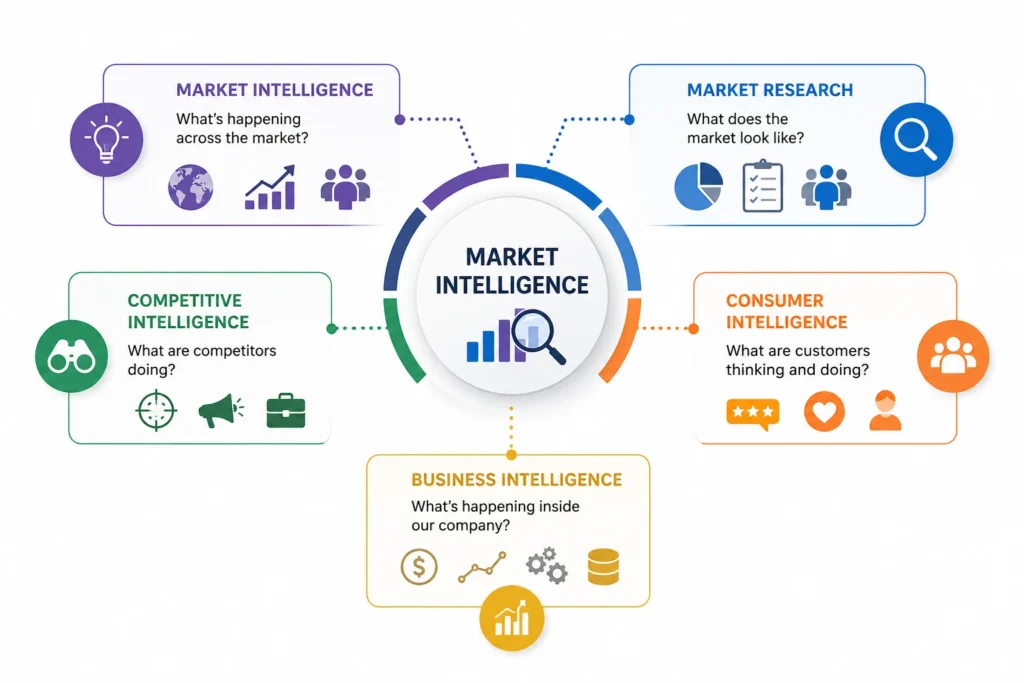
These terms are often used interchangeably, but they are not exactly the same.
| Type | Main Question | Typical Data |
|---|---|---|
| Market Intelligence | What’s happening across the market? | Competitors, demand, trends, customers, industry |
| Market Research | What does the market look like? | Surveys, interviews, market size, segments |
| Competitive Intelligence | What are competitors doing? | Pricing, products, launches, messaging, hiring |
| Consumer Intelligence | What are customers thinking and doing? | Reviews, social conversations, sentiment |
| Business Intelligence | What’s happening inside our company? | Sales, revenue, operations, CRM data |
A useful way to think about it is:
Market intelligence = the bigger picture.
Competitive intelligence is one important part of that picture.
Consumer intelligence is another.
Digital intelligence is another.
This distinction matters when choosing software because a platform built primarily for competitor battlecards may not be suitable for market sizing, while a social listening platform may be excellent for consumer sentiment but weak for financial research.
What Should a Market Intelligence Tool Do?
A good market intelligence platform should help you move through five stages:
Collect → Organise → Analyse → Interpret → Act
The strongest tools don’t simply show dashboards.
They help answer:
“What changed, why does it matter, and what should we do next?”
Depending on the platform, useful capabilities can include:
1. Competitor Monitoring
Track competitors across:
- Websites
- Product pages
- Pricing
- New features
- Press releases
- Job postings
- Advertising
- SEO
- Social media
- Partnerships
- Funding
- Acquisitions
- Reviews
2. Market Trend Analysis
Identify:
- Emerging markets
- Growing product categories
- Declining categories
- Consumer trends
- Search demand
- Technology adoption
- New competitors
- Geographic opportunities
3. Customer Intelligence
Understand:
- Customer complaints
- Product feedback
- Brand perception
- Sentiment
- Customer needs
- Emerging pain points
- Frequently discussed topics
4. Digital Market Intelligence
Analyse:
- Website traffic
- Traffic sources
- Search visibility
- Keywords
- Referrals
- Paid advertising
- Audience behaviour
- Competitor growth
5. Strategic Research
For larger organisations, market intelligence can also involve:
- Financial documents
- Industry reports
- Company research
- Patents
- Regulatory information
- M&A activity
- Investment data
- Expert research
- Technology landscapes
12 Best Market Intelligence Tools in 2026
1. Similarweb — Best Overall for Digital Market Intelligence
If your definition of market intelligence involves web traffic, digital competitors, market demand and online behaviour, Similarweb should be one of the first platforms you evaluate.
Similarweb provides digital intelligence across websites, apps, companies, markets, search, advertising and ecommerce.
Its platform can be used for:
- Competitor traffic analysis
- Market research
- Audience analysis
- Website benchmarking
- Search intelligence
- Advertising analysis
- Market share analysis
- Demand analysis
- App intelligence
- Ecommerce intelligence
Similarweb currently describes its platform as an AI-powered digital data intelligence solution and provides market, competitor, traffic and audience analysis capabilities. Its data repository includes information covering websites, apps, product SKUs, content pages, search terms and companies.
Why Similarweb stands out
The biggest advantage is its ability to connect different digital signals.
Instead of asking only:
“How much traffic does this competitor receive?”
you can investigate:
“Where does that traffic come from, what channels are growing, what audiences are involved, and how does that compare with the rest of the market?”
Best for
- Marketing teams
- Growth teams
- SEO professionals
- Ecommerce businesses
- Agencies
- Market researchers
- Competitive analysis
Main limitation
Similarweb is primarily focused on digital intelligence.
If you need deep financial research, patents, regulatory monitoring or sales battlecards, you may need another specialised platform.
Verdict: ⭐ Best overall choice for digital market intelligence.
2. Semrush — Best for SEO and Digital Competitive Intelligence
Semrush is one of the strongest choices for businesses whose market intelligence strategy is closely connected to SEO, search demand and digital marketing.
Its competitive research ecosystem can help analyse:
- Competitor websites
- Organic keywords
- Paid keywords
- Backlinks
- Traffic
- Search visibility
- Market positioning
- Audience characteristics
- Competitor growth
- Keyword gaps
Its Market Explorer is designed to provide an overview of a market, including competitors, market dynamics and audience information, while Traffic Analytics provides channel-level insights into website performance.
Semrush itself also demonstrates how its tools can be combined to identify competitors, estimate traffic, analyse traffic sources and discover keyword gaps.
Best for
- SEO teams
- Content marketers
- Digital agencies
- Affiliate marketers
- SaaS companies
- Ecommerce businesses
- Digital competitive analysis
Best use case
Suppose you’re launching a new website in a competitive niche.
Semrush can help you determine:
- Who your real search competitors are.
- Which keywords they rank for.
- Which topics generate demand.
- Where their backlink strength comes from.
- Which keywords you are missing.
- How competitors are growing in search.
Main limitation
Semrush is not a complete replacement for enterprise market intelligence platforms such as AlphaSense or CB Insights.
Its strength is digital and search intelligence, not every form of business intelligence.
Verdict: ⭐ Best market intelligence tool for SEO-driven businesses.
3. AlphaSense — Best for Enterprise Market Research
AlphaSense is aimed at organisations that need deep research rather than simply monitoring competitor websites.
It is particularly relevant for:
- Corporate strategy
- Investment research
- Financial analysis
- M&A
- Competitive intelligence
- Market research
- Enterprise decision-making
Its value comes from searching and analysing large volumes of business and financial information with AI-assisted research workflows.
Best for
- Enterprise companies
- Investment teams
- Strategy teams
- Financial analysts
- Corporate development
- M&A teams
Why it matters
Imagine a strategy team wants to understand a market before entering it.
Instead of manually reading hundreds of documents, the team can use an intelligence platform to search, compare and synthesise relevant information.
Main limitation
AlphaSense can be excessive for a small business that simply wants to know:
“How much traffic does my competitor get?”
For that use case, Similarweb or Semrush may be far more practical.
Verdict: ⭐ Excellent for deep enterprise research and strategic intelligence.
4. CB Insights — Best for Technology Market Intelligence
CB Insights is particularly powerful when your market intelligence question involves technology companies, startups, investments and emerging markets.
Its platform provides technology market intelligence covering companies, markets, funding, valuations, business relationships and other signals.
CB Insights says its platform can help users identify technology markets and companies, analyse market dynamics and build data-driven strategies.
Its data also includes funding, valuations, private-company information, market rankings, business relationships, patents and other datasets.
Best for
- Corporate strategy
- Venture capital
- Corporate venture capital
- M&A
- Innovation teams
- Technology research
- Market research
Example
A company considering investing in AI agents could use CB Insights to research:
- Emerging companies
- Funding activity
- Market maps
- Competitors
- Technology trends
- Business relationships
- Potential acquisition targets
Verdict: ⭐ One of the strongest options for technology-focused market intelligence.
5. Crayon — Best for Competitive Intelligence
Crayon focuses heavily on competitive intelligence.
Rather than simply giving you market statistics, it helps teams monitor what competitors are doing and turn those changes into intelligence that can be used by marketing and sales teams.
Crayon highlights AI capabilities for mining intelligence, generating content and helping sales teams with talk tracks and competitive plays.
Useful for monitoring
- Competitor websites
- Product changes
- Pricing
- Messaging
- Market activity
- Sales intelligence
- Competitive positioning
Best for
- Product marketing
- Competitive intelligence teams
- B2B SaaS
- Sales enablement
- Enterprise businesses
Main limitation
Crayon is much more focused on competitive intelligence than broad consumer research or digital market analytics.
Verdict: ⭐ Strong choice for teams that need continuous competitor monitoring.
6. Klue — Best for Sales and Competitive Enablement
Klue approaches competitive intelligence from a slightly different angle.
The platform is particularly useful when the objective isn’t just to collect intelligence but to put that intelligence into the hands of sales teams.
Typical applications include:
- Competitive battlecards
- Sales enablement
- Competitor intelligence
- Win/loss insights
- Sales preparation
- Competitive positioning
Klue describes its platform as a way to centralise competitive intelligence and deliver relevant insights to sellers rather than allowing intelligence to remain scattered across documents and communication channels.
Best for
- B2B sales teams
- Product marketing
- Revenue teams
- Enterprise SaaS
- Competitive enablement
Best use case
Before a sales call, a representative can access current information about:
- Competitor strengths
- Competitor weaknesses
- Pricing
- Positioning
- Objections
- Relevant battlecards
Verdict: ⭐ Excellent when market intelligence needs to directly support sales.
7. Brandwatch — Best for Consumer Intelligence and Social Listening
If you want to know what people are actually saying about a brand, product, category or competitor, Brandwatch is one of the most relevant platforms.
Its Consumer Intelligence platform collects and analyses online conversations to help organisations understand consumers, brands and markets.
It can help identify:
- Consumer sentiment
- Brand perception
- Customer complaints
- Emerging conversations
- Product feedback
- Competitor discussions
- Trends
Brandwatch says its consumer intelligence system combines large-scale historical and real-time conversation data with AI-powered analysis.
Best for
- Consumer brands
- Marketing teams
- PR teams
- Social media teams
- Brand managers
- Customer research
Main limitation
Social intelligence is only one component of market intelligence.
It won’t replace a dedicated SEO intelligence or financial research platform.
Verdict: ⭐ Best suited to understanding consumers and online conversations.
8. Contify — Best for Continuous Market and Industry Monitoring
Contify is designed around the idea that market intelligence shouldn’t be a quarterly exercise.
Its platform continuously monitors external sources and uses AI to filter, organise and summarise relevant information.
Contify says it monitors company news, regulatory updates, trade publications, patents, scientific literature, industry associations and conferences.
Its AI capabilities can also generate market insights such as:
- Industry trend summaries
- Regulatory impact assessments
- PESTLE analyses
- New entrant profiles
- Market intelligence summaries
Best for
- Strategy teams
- Market intelligence teams
- Competitive intelligence
- Corporate research
- Industry monitoring
Main advantage
The platform is designed to reduce the amount of manual monitoring required to keep up with market developments.
Verdict: ⭐ Strong option for companies that need always-on market monitoring.
9. Exploding Topics — Best for Discovering Emerging Trends
Exploding Topics takes a different approach.
Instead of primarily asking:
“What are my competitors doing?”
it helps answer:
“What is starting to grow?”
The platform focuses on identifying emerging trends, products and topics before they become mainstream.
Exploding Topics describes its technology as using AI analytics to identify trends early.
Useful for
- Product research
- Content strategy
- Startup ideas
- Ecommerce
- SEO
- Trend discovery
- New market opportunities
Example
An ecommerce entrepreneur could use trend intelligence to identify a product category that is gaining interest before the category becomes highly competitive.
Main limitation
It is a trend discovery platform rather than a complete market intelligence suite.
Verdict: ⭐ Excellent for finding emerging opportunities early.
10. Visualping — Best for Monitoring Competitor Website Changes
Sometimes market intelligence doesn’t require a massive enterprise platform.
Sometimes you simply need to know:
“Did my competitor change something?”
Visualping focuses on detecting changes to webpages.
You can monitor pages such as:
- Pricing pages
- Product pages
- Feature pages
- Careers pages
- Competitor landing pages
- Terms and policy pages
This can be surprisingly useful for competitive intelligence.
For example, if a competitor suddenly changes:
$49/month → $39/month
you may want to know immediately.
Best for
- Startups
- Freelancers
- Small businesses
- Competitor monitoring
- Price monitoring
Verdict: ⭐ A simple tool for a very specific intelligence problem.
11. Meltwater — Best for Media and Brand Intelligence
Meltwater is particularly useful for organisations that need to monitor:
- News
- Media coverage
- Brand mentions
- Public relations
- Social conversations
- Industry discussions
It can therefore form an important part of a broader market intelligence stack.
Best for
- PR teams
- Communications teams
- Enterprise marketing
- Brand monitoring
- Media intelligence
Main limitation
If your priority is SEO or website traffic, Semrush or Similarweb is likely a better fit.
Verdict: ⭐ Strong choice for media-focused market intelligence.
12. Kompyte — Best for Mid-Market Competitive Intelligence
Kompyte is focused on competitive intelligence and sales enablement, and is particularly relevant for organisations looking to monitor competitors and make competitive information accessible to revenue teams.
It can help with:
- Competitor tracking
- Battlecards
- Competitive research
- Sales enablement
- Competitor updates
It is worth considering especially if your organisation already relies heavily on the Semrush ecosystem.
Verdict: ⭐ Worth considering for mid-market teams that want competitive intelligence connected to broader marketing workflows.
Market Intelligence Tools Compared
| Tool | Market Research | Competitor Tracking | SEO | Traffic Data | Consumer Intelligence | Trends | Enterprise Research |
|---|---|---|---|---|---|---|---|
| Similarweb | ★★★★★ | ★★★★★ | ★★★★★ | ★★★★★ | ★★★ | ★★★★ | ★★★★ |
| Semrush | ★★★★ | ★★★★★ | ★★★★★ | ★★★★ | ★★ | ★★★★ | ★★★ |
| AlphaSense | ★★★★★ | ★★★★ | ★ | ★ | ★★★ | ★★★★ | ★★★★★ |
| CB Insights | ★★★★★ | ★★★★★ | ★ | ★ | ★★ | ★★★★★ | ★★★★★ |
| Crayon | ★★★ | ★★★★★ | ★★ | ★★ | ★★ | ★★★ | ★★★★ |
| Klue | ★★★ | ★★★★★ | ★ | ★ | ★★ | ★★★ | ★★★★ |
| Brandwatch | ★★★★ | ★★★★ | ★ | ★ | ★★★★★ | ★★★★★ | ★★★ |
| Contify | ★★★★★ | ★★★★★ | ★ | ★ | ★★★ | ★★★★★ | ★★★★ |
| Exploding Topics | ★★★ | ★★ | ★★★★ | ★ | ★★★ | ★★★★★ | ★★ |
| Visualping | ★ | ★★★★★ | ★ | ★ | ★ | ★ | ★ |
| Meltwater | ★★★★ | ★★★★ | ★ | ★ | ★★★★ | ★★★★ | ★★★ |
| Kompyte | ★★★ | ★★★★★ | ★★★ | ★★★ | ★★ | ★★★ | ★★★ |
Important: The star ratings above are editorial comparisons based on each platform’s primary capabilities, not vendor-reported scores.
How to Choose the Best Market Intelligence Tool
Don’t start by asking:
“Which market intelligence software is the best?”
Start by asking:
“What decision am I trying to make?”
That single question can save you thousands in software costs.
If you need competitor traffic data
Choose:
Similarweb
You want to understand:
- Traffic
- Sources
- Audience
- Competitor growth
- Digital market share
If you need SEO competitor research
Choose:
Semrush
You want:
- Keywords
- Search visibility
- Backlinks
- Organic competitors
- Paid search
- Content gaps
If you need deep financial and business research
Choose:
AlphaSense
You need:
- Company research
- Financial documents
- Strategic intelligence
- Industry research
If you analyse technology markets
Choose:
CB Insights
Especially useful for:
- Startups
- Emerging technologies
- Funding
- Market maps
- Private companies
- M&A
If your priority is competitor monitoring
Choose:
Crayon
Especially when you need continuous competitive signals.
If you’re a sales organisation
Choose:
Klue
The focus is turning competitive intelligence into sales enablement.
If you want to understand customers
Choose:
Brandwatch
Particularly useful for:
- Social listening
- Consumer sentiment
- Brand perception
- Customer conversations
If you want to find emerging trends
Choose:
Exploding Topics
Useful for discovering opportunities before they become mainstream.
What Features Should You Look for in Market Intelligence Software?
Before buying a platform, check these features.
Data Coverage
Where does the platform get its information?
Look for coverage across:
- Websites
- Search
- News
- Social media
- Reviews
- Financial data
- Patents
- Industry publications
- Company databases
More data isn’t automatically better.
Relevant and reliable data is better than huge amounts of irrelevant data.
Data Freshness
Ask:
How frequently is the information updated?
For fast-moving markets, outdated intelligence can be worse than having no intelligence.
AI Analysis
Modern platforms increasingly use AI to:
- Summarise information
- Detect changes
- Identify patterns
- Categorise signals
- Answer questions
- Generate reports
- Prioritise important events
But don’t choose a platform simply because its website says “AI-powered.”
Ask what the AI actually does.
Alerts
A strong market intelligence platform should let you receive alerts when something important happens.
For example:
Competitor X changed its pricing.
or:
Search demand for Product Y increased significantly.
or:
Five new companies entered your market.
Integrations
Check whether the platform connects with the systems your team already uses.
Potential integrations include:
- Slack
- Microsoft Teams
- Salesforce
- CRM platforms
- APIs
- Google Sheets
- Microsoft Excel
Reporting
Look for:
- Dashboards
- Automated reports
- Export options
- Scheduled reports
- Executive summaries
Data Accuracy
This is one of the most important factors.
Some platforms provide estimated traffic rather than exact first-party analytics.
For example, Semrush explicitly distinguishes estimated traffic from actual first-party website analytics.
Therefore, don’t treat an estimated competitor traffic number as if it were their internal Google Analytics data.
Are AI Market Intelligence Tools Worth It?
Yes — but only when AI is solving a real research problem.
The biggest advantage of AI is not simply generating a summary.
It is reducing the amount of time required to:
collect → filter → compare → understand → act
Traditional market research could require analysts to manually monitor dozens or hundreds of sources.
Modern platforms can continuously monitor information and use AI to identify potentially important signals.
Contify, for example, combines automated monitoring with AI-driven filtering, deduplication, tagging and human-in-the-loop checks.
CB Insights also incorporates AI-supported search across its research and company datasets.
The important question is therefore not:
“Does this tool use AI?”
but:
“Does the AI help me make a better decision faster?”
Free vs Paid Market Intelligence Tools
You don’t necessarily need an expensive enterprise platform.
Free or low-cost options
For individuals and small businesses, you can build a basic market intelligence workflow using tools such as:
- Google Trends
- Google Alerts
- Exploding Topics
- Visualping
- Free versions of SEO tools
- Social listening searches
- Company newsletters
- Public industry reports
This can be enough to validate a business idea or monitor a small number of competitors.
Paid platforms
Paid platforms become more valuable when you need:
- Larger datasets
- Historical data
- Automated monitoring
- Multiple users
- Advanced competitor analysis
- Enterprise research
- API access
- Custom reporting
- Continuous alerts
Enterprise platforms
Enterprise-grade platforms make more sense when market intelligence directly affects:
- Investment decisions
- M&A
- Product strategy
- Market entry
- Sales performance
- Corporate strategy
Can One Market Intelligence Tool Do Everything?
Usually, no.
This is one of the biggest mistakes companies make.
A tool can be excellent at one intelligence layer and weak at another.
For example:
Similarweb can give you excellent digital market intelligence, but it isn’t a replacement for a social listening platform.
Brandwatch can help you understand consumer conversations, but it isn’t an SEO research suite.
AlphaSense can be excellent for strategic research, but it isn’t designed primarily to monitor website traffic.
Klue can help sales teams use competitive intelligence, but it isn’t a full market research database.
That’s why larger organisations often build a market intelligence stack rather than relying on a single platform.
The Best Market Intelligence Stack for a Small Business
You don’t need six expensive subscriptions.
A simple stack could look like this:
Market Trends
Google Trends + Exploding Topics
Use them to discover growing demand.
SEO and Competitors
Semrush
Use it to analyse search competitors and keyword opportunities.
Digital Market Intelligence
Similarweb
Use it when you need deeper competitor traffic and digital market analysis.
Website Monitoring
Visualping
Use it to monitor important competitor pages.
This combination can provide surprisingly strong intelligence without requiring an enterprise budget.
The Best Market Intelligence Stack for a B2B SaaS Company
A B2B SaaS company may need:
Similarweb → digital market data
Semrush → SEO and search competition
Crayon or Klue → competitive intelligence
Brandwatch → customer and market conversations
AlphaSense or CB Insights → strategic and industry research
The exact combination depends on the company’s size and research requirements.
How to Use Market Intelligence Tools Properly
Buying the software is only the beginning.
A better process is:
Step 1: Define the Intelligence Question
Don’t start with the dashboard.
Start with a question.
For example:
“Why is our competitor growing faster than us?”
That’s much more useful than:
“Let’s look at the competitor dashboard.”
Step 2: Identify the Required Data
For the question above, you might need:
- Traffic
- SEO
- Paid advertising
- Product launches
- Pricing
- Content
- Audience
- Partnerships
Step 3: Collect the Signals
Use the appropriate tools to collect the information.
Step 4: Compare the Signals
Look for changes over time.
A single data point can be misleading.
A trend is usually more valuable.
Step 5: Identify the Reason
Ask:
Why did this change happen?
For example:
Traffic increased.
But why?
Perhaps:
- They launched a new product.
- They published hundreds of articles.
- They increased advertising.
- A new trend increased demand.
- A major competitor lost market share.
Step 6: Turn Intelligence Into Action
This is the step that matters most.
The output shouldn’t be:
“Competitor traffic increased 32%.”
It should be:
“Competitor traffic increased significantly after expanding into informational SEO topics. We should analyse those topics and identify gaps we can target.”
That’s intelligence.
Common Market Intelligence Mistakes to Avoid
1. Buying Too Many Tools
More software doesn’t automatically mean better intelligence.
Start with your most important business question.
2. Looking at Data Without Context
A competitor’s traffic may increase because of seasonality.
A keyword may rise because of a temporary event.
A product may receive negative reviews because of one isolated incident.
Always investigate the context.
3. Treating Estimates as Exact Numbers
Third-party platforms often estimate competitor data.
Use it for directional analysis and benchmarking, not as if you have access to the competitor’s internal analytics.
4. Collecting Intelligence Nobody Uses
A dashboard that nobody checks is not a competitive advantage.
The information must reach the people making decisions.
5. Focusing Only on Competitors
Market intelligence is bigger than competitor analysis.
You should also monitor:
- Customers
- Trends
- Technology
- Regulations
- New entrants
- Suppliers
- Distribution channels
- Search demand
6. Ignoring Small Competitors
The biggest company today isn’t necessarily the biggest threat tomorrow.
Emerging companies can sometimes reveal market shifts before established competitors do.
This is one reason technology-focused platforms such as CB Insights can be useful for identifying emerging companies and markets.
Market Intelligence Tools for Different Business Types
| Business Type | Recommended Tools |
|---|---|
| Small business | Google Trends, Exploding Topics, Semrush |
| SEO agency | Semrush, Similarweb |
| Ecommerce | Similarweb, Semrush, Brandwatch |
| SaaS startup | Semrush, Similarweb, Crayon/Klue |
| Enterprise SaaS | Klue, Crayon, Similarweb, AlphaSense |
| Technology company | CB Insights, AlphaSense, Similarweb |
| Investment firm | AlphaSense, CB Insights |
| Consumer brand | Brandwatch, Similarweb, Meltwater |
| PR agency | Meltwater, Brandwatch |
| Content business | Semrush, Exploding Topics |
| Sales organisation | Klue, Crayon |
| Market intelligence team | Contify, AlphaSense, CB Insights |
Our Final Verdict: Which Market Intelligence Tool Should You Choose?
There isn’t one universal winner.
The best platform depends on what type of intelligence you need.
🏆 Best Overall Digital Market Intelligence
Similarweb
Choose it when you want a broad view of digital markets, competitors, traffic, audiences and online behaviour.
🥇 Best for SEO and Search Intelligence
Semrush
Choose it when search visibility, keywords and digital competitors are central to your strategy.
🏢 Best for Enterprise Research
AlphaSense
Choose it for deep strategic, financial and business research.
🚀 Best for Technology Markets
CB Insights
Choose it when startups, technology markets, funding and emerging companies matter.
👀 Best for Competitor Monitoring
Crayon
Choose it when you need continuous competitive intelligence.
💼 Best for Sales Teams
Klue
Choose it when competitive intelligence needs to directly support sales conversations.
🧠 Best for Consumer Intelligence
Brandwatch
Choose it when understanding customer conversations and brand perception is your priority.
📈 Best for Emerging Trends
Exploding Topics
Choose it when your goal is to identify growing topics and market opportunities early.
🔎 Best for Simple Website Monitoring
Visualping
Choose it when you simply need to know when a competitor changes an important webpage.
Frequently Asked Questions
What are market intelligence tools?
Market intelligence tools are software platforms that collect, analyse and organise information about markets, competitors, customers, trends and industries to help businesses make better strategic decisions.
What is the best market intelligence tool in 2026?
There is no single best tool for every business. Similarweb is one of the strongest choices for digital market intelligence, Semrush is particularly strong for SEO and search intelligence, AlphaSense is suited to enterprise research, and CB Insights is particularly useful for technology markets.
What is the difference between market intelligence and competitive intelligence?
Market intelligence covers the broader market, including customers, trends, competitors and industry developments. Competitive intelligence focuses specifically on understanding competitors and their actions.
Are market intelligence tools worth the money?
They can be, especially when the information directly influences decisions about pricing, products, marketing, sales, market entry or investment. Small businesses can often start with lower-cost tools before investing in enterprise platforms.
Can AI replace market research analysts?
AI can automate many research and analysis tasks, but it does not eliminate the need for human judgement. Analysts still need to validate sources, understand context, challenge assumptions and turn information into business strategy.
Which market intelligence tool is best for startups?
For many startups, Semrush, Similarweb and Exploding Topics are practical starting points. B2B startups with a highly competitive sales environment may also benefit from tools such as Crayon or Klue.
Which tool is best for competitor analysis?
The answer depends on the type of competitor analysis. Similarweb is excellent for digital traffic and market benchmarking, Semrush is strong for SEO and search competition, while Crayon and Klue focus more heavily on competitive intelligence and sales enablement.
Are competitor traffic numbers accurate?
Competitor traffic figures from third-party platforms are generally estimates rather than first-party analytics. They are most useful for benchmarking, identifying trends and comparing competitors rather than treating individual figures as exact.
Do I need more than one market intelligence tool?
Not necessarily. A small business may only need one or two tools. Larger organisations often combine specialist platforms because market intelligence includes several different data types, including digital behaviour, customer conversations, competitor activity and strategic research.
Final Takeaway
The best market intelligence strategy isn’t about collecting the largest amount of information.
It’s about finding the right information early enough to act on it.
A strong market intelligence workflow should help you answer four questions:
What is happening?
Why is it happening?
What is likely to happen next?
What should we do about it?
For digital businesses, a combination of Semrush + Similarweb can provide a powerful foundation for understanding search, competitors and digital markets.
For enterprise strategy teams, platforms such as AlphaSense, CB Insights and Contify can provide much deeper research and market intelligence.
For consumer-focused companies, Brandwatch can add the missing layer of customer and social intelligence.
And for businesses focused on emerging opportunities, Exploding Topics can help identify trends before they become obvious.
The right choice isn’t the platform with the longest feature list.
It’s the platform that gives your team the information it needs to make better decisions faster.
[…] Best Market Intelligence Tools in 2026 […]
[…] Best Market Intelligence Tools in 2026 […]