
15 AI SEO Tools in 2026 That Can Improve Your Search Rankings
How do you optimize content for traditional search while also making it useful and understandable for AI-powered search?
That’s where AI SEO tools can help.
Modern platforms can assist with keyword research, competitor analysis, content briefs, semantic optimization, internal linking, technical SEO, content refreshing, and AI search visibility.
However, not every AI SEO tool is worth paying for.
Some are designed for enterprise SEO teams, while others are much more practical for bloggers, small businesses, and content creators.
In this guide, we’ll examine 15 AI SEO tools worth considering in 2026, what each one does, who should use it, and where it fits into a modern SEO workflow.
Quick answer: Semrush and Ahrefs are strong choices for comprehensive SEO research. Surfer, Frase, Clearscope, and NEURONwriter are useful for content optimization. Rank Math and Yoast are convenient options for WordPress users, while Semrush, Frase, and Scalenut are worth exploring if AI search visibility is part of your strategy.
What Are AI SEO Tools?
AI SEO tools are software platforms that use artificial intelligence, machine learning, natural-language processing, search data, or automated workflows to help with SEO tasks.
Depending on the platform, an AI SEO tool may help you with:
- Keyword research
- Search intent analysis
- Competitor research
- Content briefs
- Topic clustering
- Content optimization
- Semantic SEO
- Internal linking
- Technical SEO
- Meta title generation
- Meta description optimization
- Content refreshing
- Rank tracking
- AI search visibility
- Generative Engine Optimization (GEO)
The important thing to understand is that AI doesn’t replace SEO strategy.
Instead, it can reduce the amount of manual work involved in research and optimization.
Google itself continues to emphasize creating original, useful, people-first content rather than content produced primarily to manipulate search rankings.
That means the strongest approach is usually:
AI assistance + human expertise + original value.
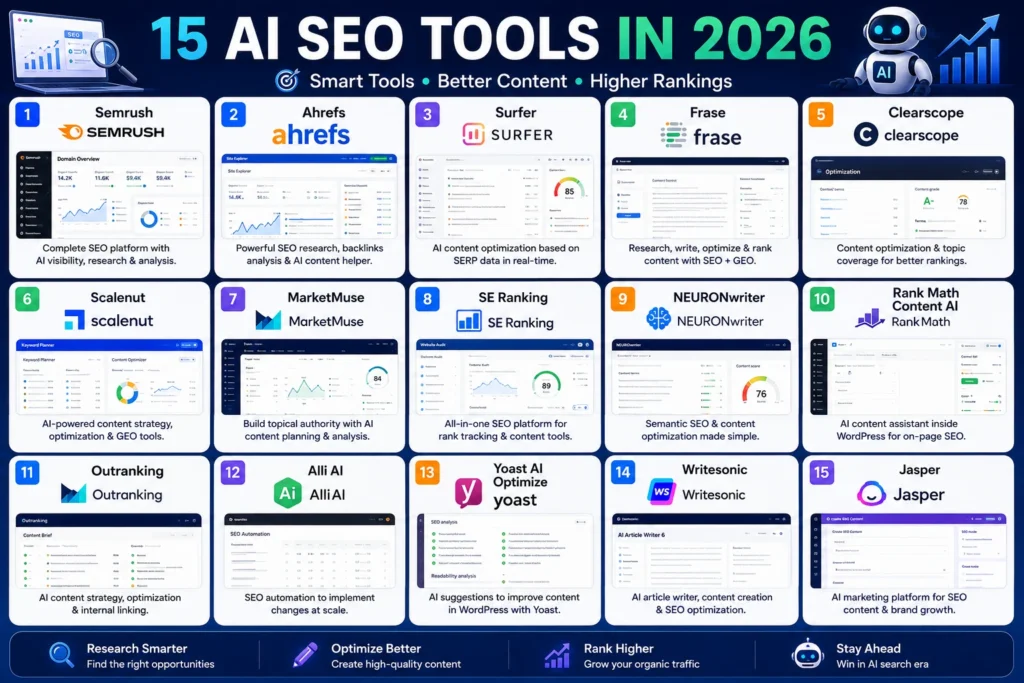
15 AI SEO Tools to Consider in 2026
| Tool | Best Use | Main Strength | Ideal For |
|---|---|---|---|
| Semrush | Complete SEO workflow | Research + AI visibility | SEO professionals |
| Ahrefs | Research & content | Backlinks + content intelligence | Bloggers & SEO teams |
| Surfer | Content optimization | SERP-based optimization | Content creators |
| Frase | SEO + AI search | Content + GEO | Bloggers & marketers |
| Clearscope | Content quality | Topic coverage | Editorial teams |
| Scalenut | Content strategy | SEO + GEO workflow | Marketers |
| MarketMuse | Topic authority | Content planning | Large websites |
| SE Ranking | SEO management | All-around SEO | Small businesses |
| NEURONwriter | Semantic SEO | Content optimization | Bloggers |
| Rank Math Content AI | WordPress SEO | In-editor optimization | WordPress users |
| Outranking | Content strategy | Optimization + internal links | Content teams |
| Alli AI | SEO automation | Automated implementation | SEO professionals |
| Yoast AI Optimize | WordPress optimization | AI-assisted editing | WordPress users |
| Writesonic | AI content | Article production | Content creators |
| Jasper | Marketing workflows | AI marketing + SEO | Marketing teams |
1. Semrush
Semrush is one of the most comprehensive SEO platforms available.
It combines many areas of digital marketing into one ecosystem, including keyword research, competitor analysis, site auditing, rank tracking, content optimization, and AI visibility.
Its newer AI visibility capabilities are designed to monitor how brands appear in AI-generated answers across platforms such as ChatGPT, Gemini, Perplexity, and Google AI experiences. Semrush says its AI visibility tools can track mentions, citations, competitors, and prompt-level visibility.
What can you use Semrush for?
- Keyword research
- Competitor analysis
- Backlink research
- Technical SEO audits
- Position tracking
- Content optimization
- AI search visibility
- Competitor gap analysis
Who should use Semrush?
Semrush is particularly suitable for:
- SEO professionals
- Agencies
- Established websites
- Businesses
- Serious publishers
The downside
Its large number of features can feel overwhelming if you’re completely new to SEO.
Verdict
A strong choice if you want one platform covering a large part of your SEO workflow.
2. Ahrefs
Ahrefs is particularly well known for backlink analysis, keyword research, competitor research, and content analysis.
In 2026, its AI Content Helper has become an important part of its content workflow.
The tool analyzes the top-ranking pages for a target keyword and evaluates how comprehensively your article covers the important topics associated with that search. Unlike simple keyword-density systems, Ahrefs says the focus is on comprehensive topic coverage rather than keyword stuffing.
Useful Ahrefs features include:
- Keyword research
- Competitor analysis
- Backlink analysis
- Search intent analysis
- Content optimization
- Topic coverage
- Content auditing
- AI-assisted content improvement
Ahrefs also offers additional AI features for areas such as search intent, keyword translation, content analysis, and site auditing.
Who should use Ahrefs?
Bloggers, publishers, SEO professionals, agencies, and businesses that take organic search seriously.
Verdict
One of the strongest choices for SEO research combined with content intelligence.
3. Surfer
Surfer is primarily focused on content optimization.
Instead of simply telling you to insert a keyword more often, Surfer analyzes search results and provides recommendations designed to improve the topical relevance and structure of your content.
Its Content Editor can help writers analyze competing pages and optimize articles while they write.
Surfer can help with:
- Content briefs
- Keyword optimization
- Content structure
- Topic coverage
- Content scoring
- AI-assisted writing
- Content optimization
Why is Surfer useful?
Imagine you’ve already written a 2,500-word article.
Instead of publishing it immediately, you can analyze it and discover that competing pages cover several important topics you haven’t addressed.
You can then improve the article before publishing.
Best suited for
Bloggers, affiliate marketers, publishers, and content teams.
Verdict
A practical option when your primary goal is improving on-page content.
4. Frase
Frase combines content research, writing, SEO optimization, and AI search visibility.
Its platform is particularly interesting because modern search isn’t limited to traditional rankings anymore.
Frase provides SEO and GEO-oriented workflows designed to help content perform in search engines and AI-powered search experiences.
Frase can help you:
- Research search results
- Analyze competitors
- Create content briefs
- Optimize articles
- Identify content gaps
- Improve topical coverage
- Explore AI search visibility
Why it matters in 2026
A page can rank well in traditional search and still have little visibility in AI-generated answers.
That’s why AI visibility is becoming an additional metric worth monitoring alongside traditional rankings.
Best suited for
Bloggers, content marketers, agencies, and publishers.
Verdict
An interesting option for websites preparing for the combination of SEO and AI search.
5. Clearscope
Clearscope focuses on content optimization and topical relevance.
The platform helps writers understand which concepts and topics should be covered in an article based on search results.
This is useful because modern SEO isn’t simply about repeating the primary keyword.
For example, if you’re writing about AI SEO tools, readers may expect information about:
- Keyword research
- Search intent
- Content optimization
- Technical SEO
- AI search
- Internal linking
- Rank tracking
- Content refreshes
An article covering these areas naturally provides a more complete answer.
Best suited for
Editorial teams, agencies, publishers, and businesses producing large amounts of content.
Verdict
A strong choice for teams that care about structured, comprehensive content.
6. Scalenut
Scalenut combines SEO research, content planning, AI writing, and optimization.
Its content workflow can help marketers move from keyword research to content creation and optimization without switching between multiple platforms.
Scalenut also focuses on Generative Engine Optimization, which aims to improve visibility across AI-powered search environments.
Useful for:
- Keyword research
- Topic clusters
- Content briefs
- AI-assisted writing
- Content optimization
- GEO
- Content planning
Who should use it?
Content marketers, bloggers, startups, and marketing teams.
Verdict
Worth considering if you want SEO and AI-search optimization in one workflow.
7. MarketMuse
MarketMuse approaches SEO from a more strategic perspective.
Instead of focusing exclusively on individual keywords, MarketMuse helps websites understand topics, content gaps, competitive coverage, and broader topical authority.
This makes it particularly interesting for large websites.
Example
Imagine you’re building an AI website.
Instead of publishing random articles about:
- AI writing
- AI images
- AI marketing
- AI video
- AI productivity
you could create organized topic clusters around broader categories.
That gives your website a stronger topical structure.
Best suited for
- Large blogs
- Publishers
- Enterprise websites
- SEO teams
- Content strategists
Verdict
A strategic choice for websites focused on building topical authority.
8. SE Ranking
SE Ranking offers an all-around SEO platform that combines keyword research, competitor analysis, rank tracking, website auditing, and content tools.
Its Content Editor can help analyze competing pages and create content briefs while providing AI-assisted content capabilities.
For smaller websites, having multiple SEO functions inside one platform can be more convenient than subscribing to several specialized tools.
Useful features include:
- Rank tracking
- Keyword research
- Website audits
- Competitor analysis
- Content optimization
- Content briefs
- Backlink monitoring
Best suited for
Small businesses, bloggers, agencies, and growing websites.
Verdict
A balanced SEO platform for users who want broad functionality without building a huge tool stack.
9. NEURONwriter
NEURONwriter focuses heavily on semantic SEO and content optimization.
It can help identify important topics, terms, structures, and content gaps associated with a target keyword.
This makes it useful for bloggers who want more control over their writing while still receiving detailed SEO guidance.
You can use it to:
- Analyze competitors
- Improve topical coverage
- Optimize headings
- Identify semantic terms
- Structure articles
- Improve content relevance
Best suited for
Bloggers, affiliate websites, content creators, and smaller SEO teams.
Verdict
A useful option for hands-on semantic content optimization.
10. Rank Math Content AI
For WordPress users, Rank Math offers an integrated SEO workflow through Content AI.
Instead of leaving WordPress to research optimization ideas, users can work directly inside the WordPress editor.
Rank Math’s Content AI can assist with keyword suggestions, headings, questions, links, metadata, and other content optimization tasks.
Why WordPress users may like it
You can keep your workflow inside WordPress:
Write → Optimize → Add metadata → Improve SEO → Publish
Best suited for
WordPress bloggers and website owners.
Verdict
A convenient option if WordPress is already the center of your publishing workflow.
11. Outranking
Outranking focuses on SEO content strategy and optimization.
The platform combines AI-assisted content workflows with SEO analysis and optimization features.
It can be useful when you’re managing a larger collection of articles and want a more structured workflow.
Useful areas include:
- Content briefs
- SEO content planning
- Content optimization
- Internal linking
- On-page SEO
- Content strategy
Best suited for
SEO professionals, agencies, and content teams.
Verdict
Worth considering when content strategy and optimization need to work together.
12. Alli AI
Alli AI takes a different approach from content-focused tools.
Its main selling point is SEO automation.
Instead of simply telling you what could be improved, the platform focuses on helping automate SEO implementation across websites.
This can be useful for:
- On-page SEO
- Technical improvements
- SEO automation
- Large websites
- Repetitive SEO tasks
Who should use it?
SEO professionals and businesses managing larger websites.
Verdict
More suitable for SEO automation than basic AI article generation.
13. Yoast AI Optimize
Yoast SEO is another major WordPress SEO solution.
Its AI features can assist with optimizing existing content and improving SEO-related elements while allowing the writer to make the final decisions.
This is particularly useful if you already use Yoast as your WordPress SEO plugin.
A practical workflow
Write the article
↓
Run the AI optimization
↓
Review suggestions
↓
Make useful changes
↓
Publish
The important part is the review step.
Don’t automatically accept every AI suggestion.
Best suited for
WordPress bloggers, publishers, and website owners.
Verdict
A convenient AI-assisted SEO layer for existing WordPress workflows.
14. Writesonic
Writesonic is primarily an AI content platform, but it includes SEO-focused article workflows.
Its AI Article Writer can support research, article creation, internal linking, citations, FAQs, and other elements depending on the selected workflow and plan.
Useful for:
- Article outlines
- AI-assisted writing
- SEO content
- FAQs
- Internal links
- Content research
- Content repurposing
But there’s a catch
Never assume an AI-generated article is ready to publish simply because it contains a keyword and headings.
Before publishing, check:
- Facts
- Sources
- Statistics
- Product information
- Examples
- Search intent
- Originality
- Internal links
- Images
- Readability
Best suited for
Content creators and publishers who want to accelerate production.
Verdict
Useful as a production assistant, not as a replacement for editorial judgment.
15. Jasper
Jasper is a broader AI marketing platform rather than a pure SEO tool.
It can help marketing teams create and optimize content while maintaining brand consistency.
Jasper has also expanded into GEO and AI search visibility, making it relevant for brands interested in how they appear across AI-powered platforms.
Best suited for
- Marketing teams
- Agencies
- Brands
- Enterprise content operations
Verdict
A strong option when SEO is part of a broader AI-powered marketing workflow.
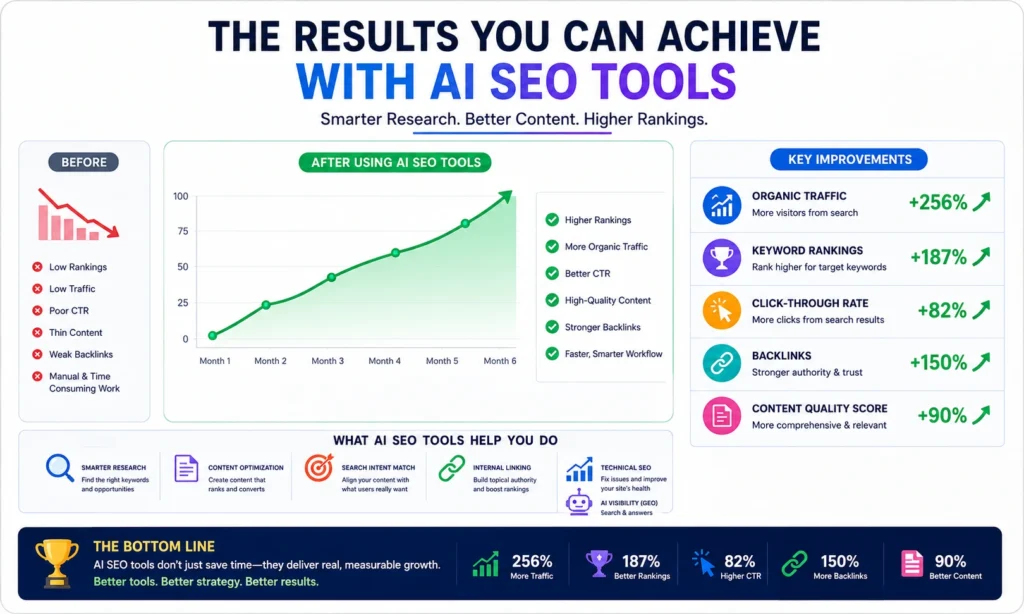
AI SEO Tools Comparison
Choosing an AI SEO tool becomes easier when you start with the problem you actually need to solve.
| Goal | Tools to Consider |
| Keyword research | Semrush, Ahrefs, SE Ranking |
| Competitor research | Semrush, Ahrefs |
| Content optimization | Surfer, Frase, Clearscope |
| Semantic SEO | NEURONwriter, Clearscope |
| Topic clusters | MarketMuse, Scalenut |
| AI search visibility | Semrush, Frase, Scalenut |
| WordPress SEO | Rank Math, Yoast |
| AI article creation | Writesonic, Jasper |
| SEO automation | Alli AI |
| Content strategy | MarketMuse, Outranking |
| Internal linking | Outranking, Rank Math |
| Large websites | Semrush, Ahrefs, MarketMuse |
How AI Is Changing SEO in 2026
The biggest change isn’t that AI can write articles.
AI can already do that.
The bigger change is how people discover information.
Google now has AI-powered search experiences, while platforms such as ChatGPT and Perplexity can answer questions directly instead of simply returning a list of links.
Google’s guidance for AI search experiences continues to emphasize the same fundamental principle it has promoted for traditional search: create unique, satisfying content that provides genuine value to visitors.
This means website owners should think about two related goals:
Traditional SEO
Search query → Search result → Click → Website
AI Search
Question → AI-generated answer → Sources/Citations → Website
You therefore need content that is:
- Clear
- Accurate
- Well structured
- Relevant
- Original
- Easy to understand
- Supported by trustworthy information
What Is AI Search Visibility?
AI search visibility refers to how frequently your website, brand, products, or content appear in AI-generated answers.
For example, someone might ask:
“Which AI SEO tools should a small business use?”
An AI system may recommend several companies and explain why.
If your brand is repeatedly absent from these answers while competitors appear, you have an AI visibility gap.
Platforms such as Semrush now provide dedicated tools for monitoring AI visibility across multiple AI search environments.
This doesn’t mean traditional Google rankings are irrelevant.
Instead, the search ecosystem is becoming broader.
How to Use AI SEO Tools Without Creating Generic Content
AI makes content production easier.
But easier content production doesn’t automatically mean better SEO.
In fact, if thousands of websites use the same AI tools to create similar articles, publishing another generic article may provide very little competitive advantage.
Google explicitly warns against using AI or automation to generate large amounts of content primarily for manipulating search rankings.
A better workflow is:
Use AI for research
Let AI help identify:
- Related topics
- Questions
- Competitors
- Content gaps
- Keyword groups
Use AI for organization
It can help create:
- Outlines
- Content briefs
- Topic clusters
- Internal-link suggestions
Use humans for differentiation
Add:
- Original examples
- Personal experience
- Product testing
- Screenshots
- Unique comparisons
- Expert opinions
- Original research
- Real-world observations
This is where your content can become significantly more valuable than a generic AI-generated page.
A Practical AI SEO Workflow for Bloggers
You don’t need 15 SEO subscriptions.
For a small website, a simple workflow can be enough.
Step 1: Find a keyword opportunity
Use a tool such as Semrush or Ahrefs to identify keywords that match your audience.
Don’t only look at search volume.
Consider:
- Search intent
- Keyword difficulty
- Relevance
- Commercial value
- Competition
- Current SERP quality
Step 2: Analyze the SERP
Search the keyword yourself.
Look at the first page.
Ask:
What are the top-ranking pages doing well?
Then ask:
What are they missing?
That second question is often more important.
Step 3: Build a better content structure
Create an outline that answers the primary question and important related questions.
For example, an article about AI SEO tools might need sections covering:
- What AI SEO tools are
- How they work
- Keyword research
- Content optimization
- AI search visibility
- Tool comparisons
- Pricing considerations
- FAQs
- Practical workflow
Step 4: Write for the reader first
Don’t write an article simply because a keyword has search volume.
Write because you can provide a useful answer.
Google’s people-first guidance specifically encourages website owners to ask whether readers will leave the page feeling that they learned enough to accomplish their goal.
Step 5: Optimize the finished article
After writing, use a content optimization platform such as:
- Surfer
- Frase
- Clearscope
- NEURONwriter
- Ahrefs AI Content Helper
Use the recommendations as guidance.
Don’t blindly change your article just to increase an optimization score.
Step 6: Strengthen internal linking
Connect your new article with relevant pages on your website.
For an AI tools website, an article about AI SEO tools could link naturally to:
- AI writing tools
- AI marketing tools
- AI tools for bloggers
- AI tools for content creators
- AI productivity tools
- AI image generators
This helps readers discover related content and gives search engines additional context about your site’s topic structure.
Step 7: Add visual information
Don’t make a 3,000-word article look like a wall of text.
Use:
- Comparison tables
- Screenshots
- Infographics
- Diagrams
- Tool logos
- Workflow graphics
- Pros and cons
- Highlight boxes
- Short paragraphs
Visual content can make complex SEO concepts easier to understand and can also improve the overall reading experience.
Step 8: Monitor performance
After publishing, track:
- Impressions
- Clicks
- CTR
- Rankings
- Organic traffic
- Conversions
- Engagement
- AI visibility where available
Then improve the article based on actual performance.
How to Choose the Right AI SEO Tool
The right tool depends on your current problem.
If you need keyword research
Start with:
Semrush or Ahrefs
If your articles aren’t ranking
Consider:
Surfer, Frase, Clearscope, or NEURONwriter
If you’re building topical authority
Consider:
MarketMuse or Scalenut
If you’re using WordPress
Consider:
Rank Math or Yoast
If you want AI search visibility
Consider:
Semrush, Frase, or Scalenut
If you need SEO automation
Consider:
Alli AI
If you mainly need AI-assisted writing
Consider:
Writesonic or Jasper
Do AI SEO Tools Actually Improve Google Rankings?
They can help, but no tool can guarantee rankings.
An AI SEO platform can help you make better decisions about:
- Keywords
- Search intent
- Content structure
- Topic coverage
- Competitors
- Internal linking
- Technical issues
But your rankings depend on much more than software.
Google’s Search Essentials include technical requirements, spam policies, and best practices, and meeting those requirements does not guarantee that a page will rank or even be indexed.
Your overall SEO performance can also depend on:
- Content quality
- Relevance
- Website authority
- Competition
- Backlinks
- Internal links
- Technical health
- Page experience
- Originality
- User satisfaction
Think of an AI SEO tool as a navigator, not an automatic ranking machine.
AI SEO vs Traditional SEO
Traditional SEO isn’t disappearing.
Instead, it’s expanding.
| Traditional SEO | Modern AI-Assisted SEO |
| Keyword research | Keyword + intent research |
| Google rankings | Google + AI visibility |
| Backlinks | Backlinks + brand/entity signals |
| Keyword optimization | Topic and entity coverage |
| Manual content briefs | AI-assisted briefs |
| Manual competitor research | AI-assisted competitor analysis |
| Rank tracking | Rank + AI visibility tracking |
| New article creation | Creation + content refreshing |
| Search traffic | Search + AI discovery |
The fundamentals remain important.
The difference is that website owners now have more places to compete for visibility.
Common Mistakes When Using AI SEO Tools
1. Chasing SEO scores
A score of 100 doesn’t automatically mean your article is excellent.
A reader doesn’t care whether your content optimization tool gave you 98 or 100.
They care whether you answered their question.
2. Keyword stuffing
Repeating the same keyword unnaturally can make content harder to read.
Use keywords naturally and focus on covering the topic comprehensively.
3. Publishing AI content without editing
AI can produce incorrect facts, outdated information, generic examples, or repetitive language.
Always review the output.
4. Creating content only because a keyword is trending
Google’s people-first guidance warns against creating large amounts of content across unrelated topics simply because they appear to have search potential.
Choose topics that fit your site’s purpose and audience.
5. Ignoring existing content
Sometimes your biggest SEO opportunity isn’t another new article.
It may be an old article that already has:
- Impressions
- Backlinks
- Rankings
- Historical traffic
- Topical relevance
Refreshing it may produce a better return than starting from zero.
6. Buying too many tools
You don’t need every tool in this article.
For a small blog, one research platform and one content optimization solution may be enough.
A Simple AI SEO Tool Stack for a Small Blog
If you’re starting an SEO-focused website, you could keep things simple.
Option 1: Research-focused
Ahrefs + WordPress SEO plugin
Good if keyword research and backlinks are your priority.
Option 2: Content-focused
Semrush + Surfer
Useful if you’re publishing many SEO articles.
Option 3: WordPress-focused
Rank Math + one research platform
Convenient for bloggers who want to manage optimization directly inside WordPress.
Option 4: AI-search focused
Semrush + Frase
Useful if you want to pay more attention to both traditional SEO and AI visibility.
Frequently Asked Questions
What are AI SEO tools?
AI SEO tools are software platforms that use artificial intelligence, search data, automation, or machine learning to assist with SEO tasks such as keyword research, content optimization, competitor analysis, technical SEO, internal linking, and AI search visibility.
Are AI SEO tools worth it in 2026?
They can be, especially when they solve a specific problem.
For example, an SEO tool can save hours of manual competitor research or help identify content gaps that might otherwise be difficult to discover.
However, buying an expensive platform won’t automatically improve your rankings.
The value comes from how effectively you use the data.
What is the easiest AI SEO tool for beginners?
For beginners, tools with focused workflows such as Surfer, Frase, NEURONwriter, Rank Math Content AI, and Yoast AI Optimize can be easier to understand than large enterprise platforms.
The best choice depends on whether you need keyword research, content optimization, WordPress integration, or AI visibility.
Can AI SEO tools guarantee Google rankings?
No.
No legitimate SEO platform can guarantee a specific Google ranking.
SEO tools provide data, recommendations, and automation, but rankings depend on many factors outside the tool itself.
Can AI-generated content rank on Google?
AI-assisted content can appear in Google Search, but using AI to mass-produce low-value pages for the purpose of manipulating rankings can violate Google’s spam policies.
Google’s guidance emphasizes useful, reliable, people-first content and warns against scaled content abuse.
Should I use AI to write my entire SEO article?
Usually, you should treat AI as an assistant rather than a complete replacement for the writer.
Use it for research, organization, brainstorming, and repetitive tasks, then add original information, examples, expertise, and human editing.
What is GEO in SEO?
GEO usually refers to Generative Engine Optimization.
It focuses on improving the likelihood that information about a website, brand, or topic is understood and surfaced by generative AI search systems.
It complements traditional SEO rather than completely replacing it.
What is AI search visibility?
AI search visibility describes how frequently a brand, website, product, or source appears in AI-generated answers.
For example, a company may rank highly in Google but not appear when users ask ChatGPT, Gemini, Perplexity, or another AI system for recommendations.
Is traditional SEO still important in 2026?
Yes.
Google Search remains an important source of organic discovery, and Google’s own guidance for AI search continues to emphasize fundamentals such as unique, helpful content, good page experience, and crawlable pages.
Which AI SEO tool should a blogger choose?
A blogger should start with the problem rather than the tool.
For keyword research and competitor analysis, consider Semrush or Ahrefs.
For content optimization, consider Surfer, Frase, Clearscope, or NEURONwriter.
For WordPress, Rank Math and Yoast are convenient options.
For AI search visibility, Semrush and Frase are worth investigating.
How many AI SEO tools do I need?
Probably fewer than you think.
For most small websites, one SEO research platform plus one content optimization solution can cover a large part of the workflow.
Using five or six overlapping tools often creates more complexity than value.
Final Verdict: Which AI SEO Tool Should You Use?
There is no universal winner because every website has different needs.
If you need a broad SEO platform, Semrush is a strong candidate.
If backlink research and content intelligence are priorities, Ahrefs deserves serious consideration.
If content optimization is your main concern, look at Surfer, Frase, Clearscope, or NEURONwriter.
If you’re building topical authority, MarketMuse can be especially interesting.
If you’re a WordPress user, Rank Math or Yoast can simplify your workflow.
And if AI-powered search is becoming an important part of your strategy, consider platforms that can measure and analyze AI visibility, not just traditional keyword rankings.
The most important lesson, however, is this:
Don’t use AI SEO tools simply to produce more content. Use them to produce better content.
The goal isn’t to publish 100 generic articles.
The goal is to build a website where every important page answers a real question, solves a real problem, provides original value, and gives readers a reason to stay.
That is a much stronger SEO strategy for 2026 and beyond.
Sources and Further Reading
- Google Search Essentials
- Google’s guidance on helpful, reliable, people-first content
- Google’s guidance on generative AI content
- Google’s guidance for AI search experiences
- Semrush AI Visibility
- Ahrefs AI Content Helper
Suggested Internal Links
To strengthen the site’s topical structure, link this article naturally to related TechVello articles such as:
- AI Tools for Content Creators
- AI Writing Tools for Bloggers
- AI Marketing Tools
- AI Tools for Small Businesses
- AI Productivity Tools
- AI Image Generators
- AI Video Tools
- How to Use AI for SEO