

The best AI SEO tools in 2026 can help you discover keyword opportunities, analyze search results, build content briefs, optimize existing articles, identify technical problems, and turn large amounts of SEO data into practical recommendations.
But there’s a catch.
Not every tool marketed as an “AI SEO tool” is actually useful.
Some are excellent for content optimization. Others are much better for keyword research, technical SEO, competitor analysis, or building content strategies. And a few are mostly AI writing tools with an SEO label added on top.
So instead of giving you a random list, this guide compares the best AI SEO tools for different SEO jobs, including what each tool does well, who it’s for, and where it falls short.
Quick Answer: What Are the Best AI SEO Tools in 2026?
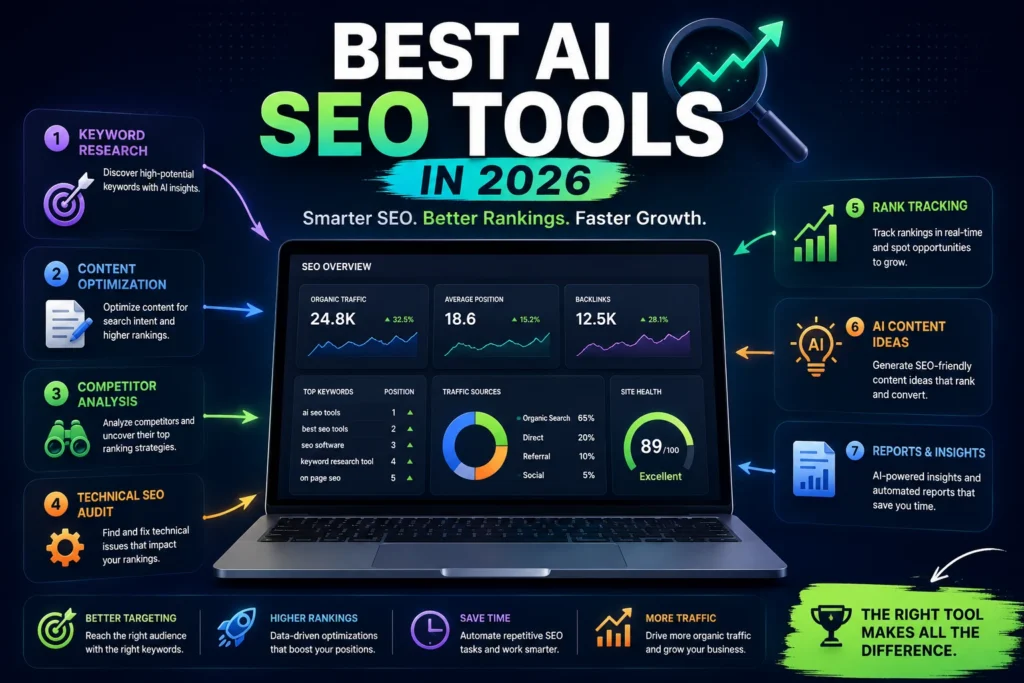
If you don’t want to read the entire guide, here’s the shortlist:
| AI SEO Tool | Best For | Our Take |
|---|---|---|
| Semrush | All-in-one SEO | Best overall |
| Ahrefs | Backlinks & SEO research | Best for SEO data |
| Surfer | Content optimization | Best for on-page SEO |
| Clearscope | Content quality | Best for editorial teams |
| Frase | AI content + SEO | Best for content workflows |
| Scalenut | AI SEO content | Best for content planning |
| NeuronWriter | Affordable optimization | Best value |
| MarketMuse | Content strategy | Best for larger sites |
| SE Ranking | SEO platform | Best Semrush alternative |
| Alli AI | SEO automation | Best for automation |
| Rank Math | WordPress SEO | Best WordPress option |
| Jasper | Marketing content | Best for teams |
| WriterZen | Keyword research | Best for topic discovery |
| LowFruits | Low-competition keywords | Best for smaller sites |
| Keyword Insights | Keyword clustering | Best for content architecture |
What Is an AI SEO Tool?
An AI SEO tool uses artificial intelligence or machine-learning systems to help automate or improve SEO tasks.
Depending on the platform, AI can assist with:
- Keyword research
- Search intent analysis
- Content briefs
- Topic clustering
- Competitor analysis
- Content optimization
- Internal linking
- Technical SEO
- SERP analysis
- SEO audits
- Meta titles and descriptions
- Content gap analysis
- Keyword clustering
- Content generation
The important distinction is that AI SEO software isn’t necessarily an AI writer.
A good AI SEO platform should help you make better SEO decisions—not simply generate 2,000 words and tell you to publish them.
1. Semrush — Best Overall AI SEO Tool
Best for: Complete SEO workflows
Semrush remains one of the most comprehensive platforms for SEO professionals because it combines keyword research, competitor research, technical SEO, content optimization, backlink analysis, rank tracking, and AI-powered features.
Its biggest advantage is breadth.
Instead of switching between five different platforms, you can perform much of your SEO research inside one ecosystem.
What Semrush is good at
- Keyword research
- Competitor analysis
- Keyword gap analysis
- Backlink research
- Site audits
- Rank tracking
- Content optimization
- SEO writing workflows
- Topic research
- SERP analysis
Pros
- Extremely comprehensive
- Excellent competitive research
- Large SEO database
- Strong technical SEO features
- Useful AI-powered content features
- Suitable for agencies and serious websites
Cons
- Can be expensive
- Large number of features can feel overwhelming
- More than a small website may need
Best for
If you want one serious SEO platform that covers almost everything, Semrush is one of the safest choices.
2. Ahrefs — Best for SEO Data and Backlinks
Best for: Backlink research, keywords, and competitive SEO analysis
Ahrefs has built a strong reputation around SEO data, particularly backlinks and organic search research.
It’s especially useful when you want to understand why another website is ranking.
You can research:
- Organic keywords
- Competing pages
- Backlinks
- Referring domains
- Content gaps
- SERP competitors
- Keyword opportunities
- Traffic trends
Why Ahrefs stands out
SEO isn’t only about writing better content.
Sometimes the bigger opportunity is discovering:
“Why is this competitor ranking while my page isn’t?”
Ahrefs can help answer that question by combining keyword, backlink, and competitor data.
Pros
- Excellent backlink database
- Powerful competitor research
- Strong keyword analysis
- Great content-gap analysis
- Clean interface
Cons
- Can be expensive
- Advanced features may be unnecessary for beginners
Best for
SEO professionals, publishers, agencies, and website owners who care deeply about competitive research.
3. Surfer — Best AI SEO Tool for Content Optimization
Best for: On-page SEO and content optimization
Surfer focuses heavily on helping content creators understand what competitive pages are doing and how their content compares.
Instead of asking AI:
“Write me an SEO article.”
You can use a content optimization platform to ask:
“What does the search landscape suggest this page needs?”
That difference matters.
Surfer can help with
- Content optimization
- Content scores
- SERP analysis
- Content briefs
- Keyword recommendations
- Content structure
- AI-assisted writing
Pros
- Easy to understand
- Strong content optimization workflow
- Useful for writers
- Good SERP-based recommendations
Cons
- Not a complete replacement for an SEO suite
- Content recommendations shouldn’t be followed blindly
Best for
Bloggers and content teams that already have keyword research but need help improving on-page optimization.
4. Clearscope — Best for Content Quality
Best for: Editorial teams and publishers
Clearscope focuses on making content more comprehensive and aligned with search intent.
Its approach is less about producing huge amounts of AI content and more about helping writers create pages that cover a topic properly.
Useful features include
- Content optimization
- Keyword recommendations
- Content grading
- Topic coverage
- SERP research
- Content briefs
Pros
- Simple workflow
- Strong editorial focus
- Helpful for content teams
- Easy for writers to understand
Cons
- Primarily content-focused
- Less suitable if you need extensive technical SEO features
Best for
Editorial teams that prioritize content quality over mass AI generation.
5. Frase — Best for AI Content + SEO
Best for: Bloggers and content marketers
Frase combines SEO research, content briefs, optimization, and AI writing capabilities.
This makes it useful for people who want to go from:
Keyword → SERP research → outline → draft → optimization
inside one workflow.
Why Frase is useful
It reduces the number of separate tools you need for content production.
You can research the SERP, understand competing content, create an outline, and then optimize the resulting article.
Pros
- Strong content workflow
- Useful AI writing features
- Good research capabilities
- Beginner-friendly
Cons
- Not a full technical SEO platform
- AI output still needs human editing
Best for
Bloggers and small content teams publishing regularly.
6. Scalenut — Best for AI-Powered Content Planning
Best for: Content planning and AI-assisted SEO writing
Scalenut combines keyword research, content planning, optimization, and AI content generation.
It’s particularly interesting for websites that want to build content around broader topics instead of publishing isolated keyword-targeted articles.
Pros
- AI-assisted content planning
- Keyword research
- Content optimization
- Topic clustering
- Writing assistance
Cons
- Can take time to learn
- Some features overlap with dedicated SEO platforms
Best for
Content marketers building larger topic clusters.
7. NeuronWriter — Best Affordable AI SEO Tool
Best for: Bloggers who want content optimization without paying for a huge SEO suite
NeuronWriter has become popular among smaller publishers because it focuses heavily on content optimization while remaining more accessible than some enterprise-level platforms.
It can help analyze competing content and provide recommendations around:
- Keywords
- Topics
- Content structure
- Semantic terms
- Content optimization
Pros
- Affordable compared with enterprise platforms
- Useful content optimization
- Good for bloggers
- Straightforward workflow
Cons
- Doesn’t replace a complete SEO suite
- Less comprehensive than Semrush or Ahrefs
Best for
Small websites and bloggers who primarily need on-page SEO assistance.
8. MarketMuse — Best for Content Strategy
Best for: Content-heavy websites
MarketMuse takes a broader approach to content intelligence.
Instead of optimizing one article at a time, it can help organizations understand their overall topical coverage and identify areas where their content strategy is weak.
This becomes increasingly useful as a website grows.
Useful for
- Topic authority
- Content planning
- Content gaps
- Topic modeling
- Content inventory
- Content prioritization
Best for
Publishers and larger websites managing substantial content libraries.
9. SE Ranking — Best Semrush Alternative
Best for: All-in-one SEO at a more accessible price point
SE Ranking combines many of the features website owners expect from a modern SEO platform.
These include:
- Keyword research
- Rank tracking
- Website audits
- Competitor analysis
- Backlink monitoring
- Content tools
- SEO reporting
Pros
- Broad feature set
- Good for agencies
- Rank tracking
- Competitor analysis
- Often easier for smaller businesses to adopt
Cons
- Some advanced capabilities are not as deep as specialized tools
Best for
Small businesses, agencies, and website owners looking for an all-in-one SEO platform.
10. Alli AI — Best for SEO Automation
Best for: Automating repetitive SEO tasks
Alli AI takes a different approach from content-first platforms.
Its main appeal is automation.
For larger websites, repetitive SEO changes can consume enormous amounts of time. Automation can help identify and implement certain optimization opportunities at scale.
Best for
- Large websites
- SEO agencies
- Technical teams
- Enterprise SEO
- Automated optimization
Main advantage
Scale.
If you’re managing thousands of pages, manually optimizing every page isn’t realistic.
11. Rank Math — Best AI SEO Plugin for WordPress
Best for: WordPress websites
If your website runs on WordPress, Rank Math is one of the most practical SEO tools to consider.
It combines traditional WordPress SEO features with AI-assisted content and optimization functionality.
You can use it for:
- Meta titles
- Meta descriptions
- Schema
- XML sitemaps
- SEO analysis
- Internal linking assistance
- On-page optimization
- AI content features
Why it matters
You don’t always need an expensive standalone SEO platform.
For a WordPress blog, a strong SEO plugin combined with a dedicated keyword/content tool can be enough.
Best for
WordPress bloggers and publishers.
12. Jasper — Best AI SEO Tool for Marketing Teams
Best for: Marketing teams
Jasper is primarily an AI marketing platform rather than a traditional SEO crawler or backlink database.
Its value comes from helping teams produce and manage marketing content at scale.
It can be useful for:
- Blog content
- Landing pages
- Marketing copy
- Brand voice
- Campaign content
- Content repurposing
Best for
Marketing departments that want AI content production integrated into broader workflows.
13. WriterZen — Best for Keyword and Topic Discovery
Best for: Keyword research and content planning
WriterZen focuses on finding keyword opportunities and organizing them into useful content plans.
For bloggers, one of its biggest benefits is reducing the guesswork involved in deciding:
“What should I write about next?”
Best for
- Keyword discovery
- Keyword clustering
- Topic planning
- Content research
14. LowFruits — Best for Low-Competition Keywords
Best for: New and smaller websites
This is one of the tools I’d pay particular attention to if you’re building a relatively young website.
Instead of trying to compete immediately for massive keywords dominated by established websites, LowFruits focuses on identifying search opportunities where weaker websites are already ranking.
That can lead to a much more realistic content strategy.
Example
Instead of targeting:
best AI tools
you might discover opportunities around:
best AI SEO tools for small blogs
The second keyword may have a smaller audience, but it can be much easier to compete for.
Best for
New websites, niche bloggers, and publishers targeting long-tail keywords.
15. Keyword Insights — Best for Keyword Clustering
Best for: Building content clusters
Keyword clustering is becoming increasingly important because creating hundreds of separate articles around nearly identical keywords can create unnecessary competition between your own pages.
Keyword Insights helps group related keywords based on search behavior and SERP similarity.
That can help you decide whether you need:
One comprehensive article
or
Several separate pages.
Best for
SEO professionals building scalable content architectures.
Best AI SEO Tools by Use Case
Instead of asking which tool is “best” overall, ask which tool is best for your job.
| Your Goal | Best Choice |
|---|---|
| Complete SEO platform | Semrush |
| Backlink research | Ahrefs |
| Content optimization | Surfer |
| Editorial SEO | Clearscope |
| AI content workflow | Frase |
| Topic planning | Scalenut |
| Affordable optimization | NeuronWriter |
| Content strategy | MarketMuse |
| Semrush alternative | SE Ranking |
| SEO automation | Alli AI |
| WordPress SEO | Rank Math |
| Marketing content | Jasper |
| Keyword discovery | WriterZen |
| Low-competition keywords | LowFruits |
| Keyword clustering | Keyword Insights |
How to Choose the Right AI SEO Tool
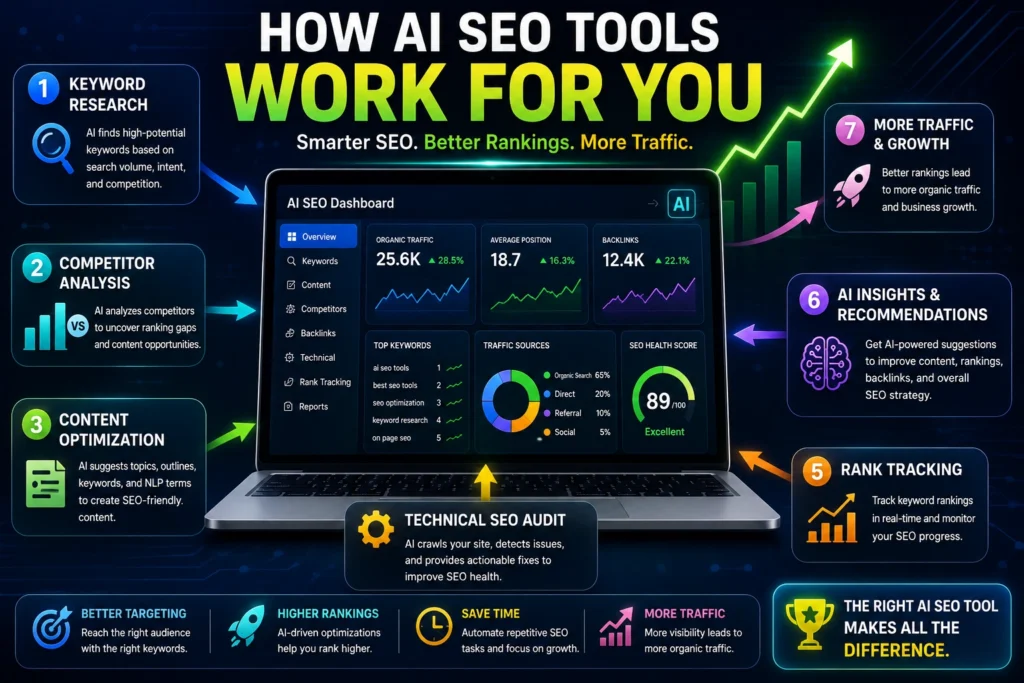
The biggest mistake is choosing an SEO tool because it has the longest feature list.
Instead, start with your actual problem.
If You Have a New Website
Don’t immediately spend a fortune on enterprise SEO software.
Your priorities should probably be:
- Find realistic keywords.
- Understand search intent.
- Identify weak competitors.
- Build topical authority.
- Create genuinely useful content.
- Track rankings.
- Improve existing pages.
Tools such as LowFruits, Rank Math, and NeuronWriter can be useful parts of this workflow.
If You Run a Content Website
Your biggest bottleneck is often not technical SEO.
It’s deciding:
What should I publish?
How should I structure it?
What topics should I cover next?
Which existing pages should I improve?
That’s where platforms such as Semrush, Ahrefs, Surfer, MarketMuse, Scalenut, and Keyword Insights become more valuable.
If You Run an SEO Agency
You’ll probably need:
- Rank tracking
- Competitor analysis
- Site audits
- Reporting
- Backlink research
- Keyword research
- Content workflows
- Client management
An all-in-one platform such as Semrush or SE Ranking may make more sense than stitching together many small tools.
Can AI SEO Tools Replace an SEO Expert?
No—not completely.
And this is one of the biggest misconceptions surrounding AI SEO.
AI is excellent at processing large amounts of information.
It can help identify:
- Patterns
- Keywords
- Content gaps
- Technical issues
- Topic relationships
- Optimization opportunities
But it doesn’t automatically understand your:
- Business
- Customers
- Brand
- Products
- Expertise
- Competitive advantages
- Conversion goals
A page can be perfectly optimized for search engines and still be terrible for humans.
That’s why the strongest SEO workflow in 2026 isn’t:
AI → Publish
It’s:
Data → AI assistance → Human expertise → Editing → Publish → Measure → Improve
How to Use AI for SEO Without Destroying Your Content
AI can dramatically speed up SEO work, but speed isn’t the same as quality.
A better workflow looks like this:
1. Start with the searcher’s problem
Don’t start by asking:
“What keyword should I rank for?”
Start with:
“What does the person searching this actually want?”
2. Research the SERP
Look at the pages currently ranking.
Ask:
- What questions do they answer?
- What do they miss?
- What format dominates?
- Are searchers looking for a guide, list, comparison, tool, or tutorial?
3. Use AI for research assistance
AI can help organize:
- Keywords
- Questions
- Topics
- Entities
- Content gaps
4. Add something original
This is where many AI-generated articles fail.
Add:
- Your own analysis
- Comparisons
- Examples
- Screenshots
- Testing
- First-hand observations
- Better explanations
- Clear recommendations
5. Edit aggressively
Don’t publish AI output simply because it sounds grammatical.
Remove:
- Repetition
- Generic introductions
- Empty claims
- Obvious filler
- Unnecessary paragraphs
6. Update based on performance
SEO doesn’t end when you press Publish.
Watch:
- Impressions
- Click-through rate
- Rankings
- Engagement
- Conversions
Then improve the page.
AI SEO vs Traditional SEO
AI isn’t really replacing SEO.
It’s changing how SEO is performed.
| Traditional SEO | AI-Assisted SEO |
|---|---|
| Manual keyword research | AI-assisted discovery |
| Manual competitor analysis | Automated SERP analysis |
| Manual topic grouping | Keyword clustering |
| Manual content briefs | AI-generated briefs |
| Manual optimization | AI recommendations |
| Manual audits | Automated issue detection |
| Manual reporting | Automated insights |
| Human-only workflow | Human + AI workflow |
The human remains responsible for the strategy.
AI simply makes many parts of the process faster.
Are AI-Generated Articles Good for SEO?
They can be—but AI generation itself isn’t what makes content rank.
Search engines care about whether a page is useful and satisfies the searcher’s intent.
A generic AI article that repeats information already available everywhere isn’t a strong SEO strategy.
A better approach is to use AI as a productivity layer while making the final content genuinely useful.
For example:
Weak workflow:
Keyword → AI writer → Publish
Better workflow:
Keyword → Search intent → SERP research → Original angle → AI assistance → Human editing → Useful visuals → Internal links → Publish → Measure → Update
That second workflow takes more effort.
It’s also far more likely to create a website worth returning to.
My Recommended AI SEO Stack for 2026
You don’t need 15 subscriptions.
For most website owners, I’d build a small stack.
For keyword research
Semrush or Ahrefs
For finding easier opportunities
LowFruits
For WordPress SEO
Rank Math
For content optimization
Surfer or NeuronWriter
For AI-assisted content research
Frase
For keyword clustering
Keyword Insights
You can then combine those tools with your own judgment instead of allowing one platform to make every SEO decision.
Final Verdict: Which AI SEO Tool Should You Use?
The best AI SEO tool depends on what you’re trying to accomplish.
Semrush is the strongest all-around option if you want one platform covering most SEO tasks.
Ahrefs is excellent when backlinks and competitive SEO research are your priorities.
Surfer is a strong choice for optimizing content around existing search results.
Frase works well for bloggers who want SEO research and AI content workflows together.
LowFruits is especially interesting for newer websites that need realistic keyword opportunities.
Rank Math makes sense for WordPress users who want SEO functionality directly inside their website.
And if you’re managing a large website, tools such as MarketMuse and Alli AI become more interesting because they focus on scaling SEO and content operations.
But here’s the most important point:
The best AI SEO tool isn’t the one with the most AI features. It’s the one that helps you make better SEO decisions and create genuinely better pages.
AI can find patterns.
AI can analyze data.
AI can speed up research.
AI can help you write.
But your competitive advantage is what you do with that information.
If you combine AI with strong search-intent research, original insights, useful content, and consistent optimization, AI SEO tools can become a serious advantage rather than just another collection of software subscriptions.
Frequently Asked Questions
What is the best AI SEO tool in 2026?
Semrush is one of the strongest all-in-one options, while Ahrefs, Surfer, Frase, LowFruits, and Rank Math can be better choices depending on your specific SEO needs.
What is the best AI SEO tool for beginners?
Beginners may find tools such as Frase, Surfer, Rank Math, and NeuronWriter easier to start with than large enterprise SEO platforms.
What is the best AI SEO tool for keyword research?
Semrush and Ahrefs are strong choices for comprehensive keyword research. LowFruits is particularly useful when your goal is finding lower-competition opportunities.
Can AI SEO tools improve Google rankings?
They can help improve the research, optimization, and content-development process, but no tool can guarantee rankings. Search performance depends on content quality, relevance, competition, authority, technical SEO, and many other factors.
Are AI SEO tools worth paying for?
They can be, especially if they save significant research and optimization time. However, a small website usually doesn’t need several expensive SEO subscriptions at once.
Can I use multiple AI SEO tools together?
Yes. In fact, a combination can be more effective than relying on one platform. For example, you could use Semrush for keyword research, LowFruits for finding easier opportunities, Rank Math for WordPress SEO, and Surfer or NeuronWriter for content optimization.
Do AI SEO tools replace human SEO?
No. They automate and accelerate many SEO tasks, but strategy, expertise, originality, and editorial judgment remain important.
What should I look for in an AI SEO tool?
Look for reliable data, useful keyword research, search-intent analysis, SERP insights, content optimization, technical SEO capabilities, integrations, ease of use, and a price that matches your actual workflow.
[…] Best AI SEO Tools in 2026: 15 Tools Worth Using […]
[…] Best AI SEO Tools in 2026: 15 Tools Worth Using […]