
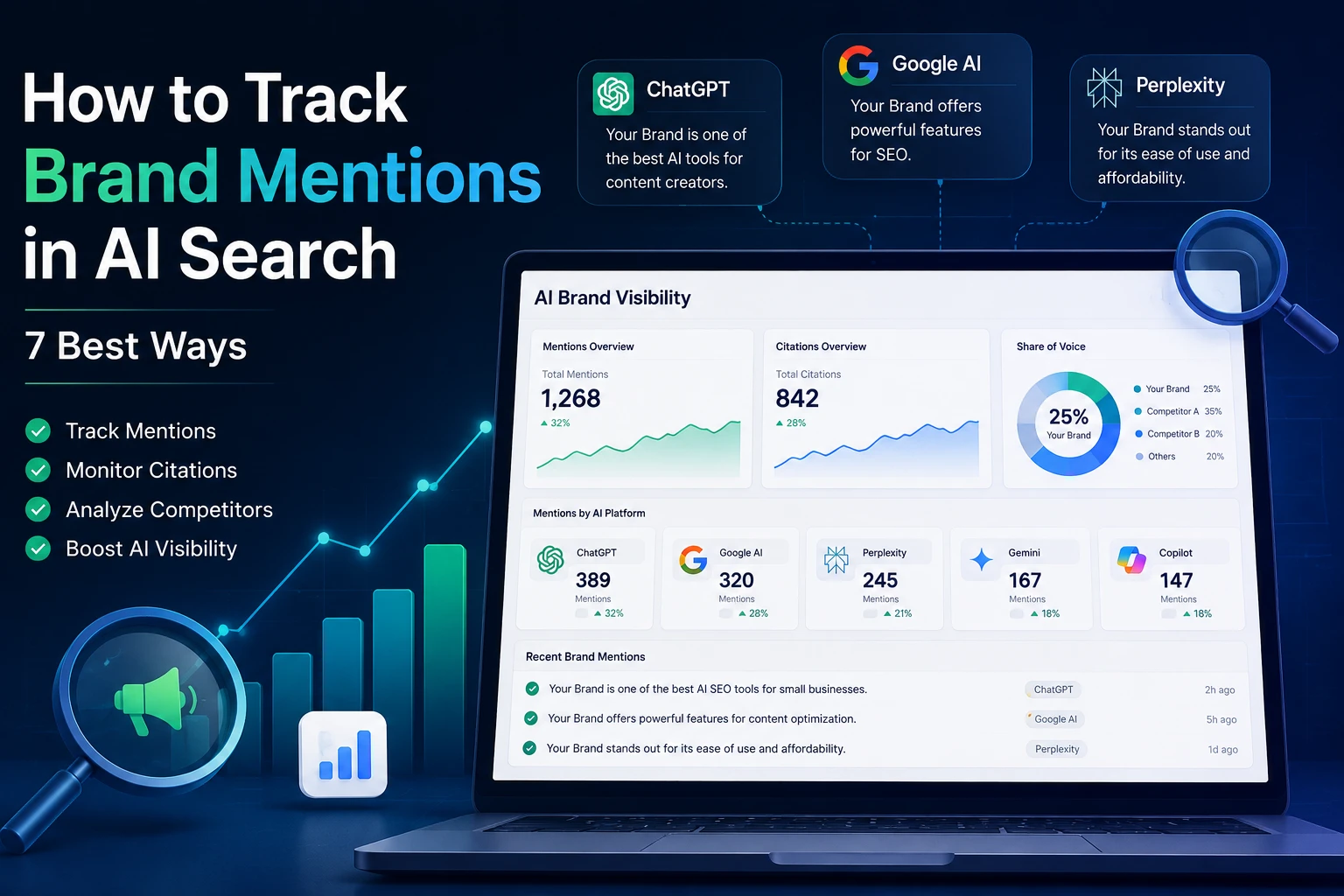
AI search is changing how people discover products, companies, websites, and services.
Instead of opening Google and comparing ten blue links, users can now ask AI-powered search systems questions such as:
“What are the best AI SEO tools for a small business?”
The answer may mention several brands, recommend one company over another, or cite specific websites as sources.
That creates a new SEO question for businesses:
Is your brand actually appearing when people ask AI about your industry?
Traditional Google rankings don’t give you the complete answer. A website can rank well for conventional keywords while rarely being mentioned or cited in AI-generated answers.
That’s why AI search visibility and brand mention tracking are becoming important parts of modern SEO.
In this guide, you’ll learn 7 practical ways to track brand mentions in AI search, including ChatGPT, Google AI features, Perplexity, manual tracking, monitoring tools, and a simple system you can use every week.
What Are Brand Mentions in AI Search?
An AI brand mention happens when an AI-powered search or answer system refers to your company, product, website, or brand in its response.
For example, imagine someone asks:
“What are the best AI SEO tools for small businesses?”
An AI search engine might respond:
“Some popular options include Brand A, Brand B, and Brand C.”
If your company appears in that answer, you’ve earned an AI brand mention.
But there are several different types of visibility worth tracking.
Brand mention
The AI system simply names your company or product.
Brand recommendation
The AI actively recommends your company as an option.
Brand citation
Your website or a specific page is used as a source for the answer.
Competitor mention
A competing company appears instead of your brand.
These distinctions matter because being mentioned isn’t necessarily the same as being cited or recommended.
For example, ChatGPT Search can provide answers with citations and links to relevant web sources, while Perplexity describes its answers as being backed by verifiable sources and citations.
Why Should You Track Brand Mentions in AI Search?
AI visibility isn’t simply another vanity metric.
It can tell you how AI systems perceive and represent your brand when users ask questions related to your market.
Here are some of the biggest reasons to monitor it.
1. AI can introduce your brand to new customers
Someone may never search your company name directly.
Instead, they might ask:
“What’s the best tool for X?”
If your brand appears in the answer, you’ve entered the user’s consideration set.
2. Your competitors may be getting mentioned instead
Imagine your competitor appears in 70% of relevant AI answers while your company appears in only 10%.
That’s a useful competitive signal.
3. AI can cite your content
A mention is useful, but a citation to your website can potentially send a user directly to your content.
Perplexity, for example, says its responses include citations and links to original sources.
4. AI can represent your brand incorrectly
Monitoring isn’t only about visibility.
You should also check whether AI systems are presenting:
- outdated pricing
- incorrect features
- old product information
- wrong company descriptions
- incorrect comparisons
5. Traditional SEO doesn’t tell the whole story
Google rankings remain important. In fact, Google’s current guidance says its normal SEO best practices continue to matter for generative AI features in Search.
But AI visibility gives you another question to measure:
When people ask AI about my category, does my brand appear?
7 Best Ways to Track Brand Mentions in AI Search
1. Search for Your Brand Manually
The easiest way to start is also the cheapest:
Ask AI directly.
You don’t need an expensive platform when you’re establishing your first baseline.
Start with questions related to your products, services, category, and customers.
For example:
“What are the best AI SEO tools for small businesses?”
“Which AI SEO tools would you recommend for a content creator?”
“What are the best alternatives to [Competitor]?”
“Which tools can help a website improve its visibility in AI search?”
“What are the best AI marketing platforms in 2026?”
Then record whether your brand appears.
Create a simple tracking table
| Prompt | Platform | Mentioned? | Recommended? | Cited? | Competitors |
|---|---|---|---|---|---|
| Best AI SEO tools? | ChatGPT | Yes | Yes | Yes | 3 |
| Best AI SEO tools? | Perplexity | No | — | — | 5 |
| AI marketing tools for SMBs? | Yes | No | Yes | 2 |
The important part is consistency.
Don’t ask one random question today and a completely different question next month.
Build a fixed collection of prompts and reuse them.
2. Build a Consistent AI Search Prompt Set
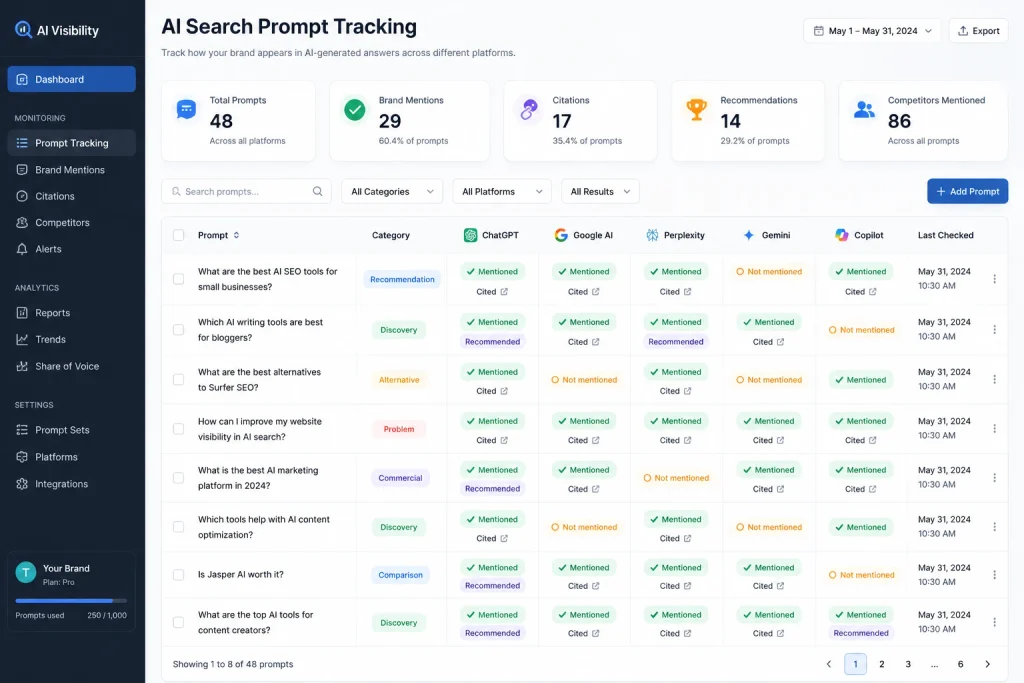
This is one of the most important steps.
If you want meaningful data, create a list of questions that represent the searches your potential customers might actually make.
I recommend starting with 20–50 prompts.
Divide them into categories.
Discovery prompts
“What are the best AI tools for content creators?”
Comparison prompts
“[Brand] vs [Competitor]: which is better?”
Recommendation prompts
“What AI SEO tool should a small business use?”
Problem-based prompts
“How can I improve my visibility in AI search?”
Alternative prompts
“What are the best alternatives to [Competitor]?”
Buying-intent prompts
“What is the best AI marketing platform for a small business?”
This approach gives you a much better picture than simply searching your company name.
3. Track Your Brand Mentions in ChatGPT
ChatGPT is one of the platforms worth monitoring when your customers use AI to research products and services.
The important thing is not simply asking:
“What is [Brand]?”
Instead, ask questions where your brand should logically compete.
For example:
“What are the best AI writing tools for bloggers?”
“What are the best SEO tools for a new website?”
“Which AI tools are best for small businesses?”
“What are the alternatives to [Competitor]?”
Then record:
- Was your brand mentioned?
- Was it recommended?
- Where did it appear?
- Was your website cited?
- Which competitors appeared?
- Which pages were cited?
ChatGPT’s official documentation explains that its web search can return current information with links to relevant web sources and that users can open cited sources to verify them.
https://help.openai.com/en/articles/9237897?utm_source=chatgpt.com
Important
Don’t treat one ChatGPT response as a permanent ranking.
AI responses can change depending on the query, context, sources, and time.
Your goal is to measure patterns over repeated tests.
4. Monitor Google AI Overviews and AI Mode
Google is another important part of AI search visibility.
Google’s AI-powered Search experiences can surface information from multiple web sources, meaning traditional blue-link rankings aren’t the only visibility opportunity anymore.
Google has also published specific guidance for optimizing content for its generative AI features, while emphasizing that established SEO fundamentals still matter.
For your tracking system, record:
- Target query
- Whether an AI Overview appears
- Whether your brand appears
- Whether your website is cited
- Which page is cited
- Which competitors appear
For example:
| Query | AI Feature | Brand Mention | Citation | Competitor |
|---|---|---|---|---|
| best AI SEO tools | AI Overview | Yes | Yes | Brand B |
| AI marketing tools | AI Overview | No | — | Brand C |
| AI tools for bloggers | AI Mode | Yes | Yes | Brand B |
Google’s documentation also confirms that AI Overviews and AI Mode can include source-related experiences, and Search Console reporting has been updated to account for AI features.
https://developers.google.com/search/updates?utm_source=chatgpt.com
https://developers.google.com/search/docs/appearance/preferred-sources?utm_source=chatgpt.com
5. Track Brand Mentions on Perplexity and Other AI Search Engines
Don’t monitor only one platform.
Different AI search systems can produce different answers and cite different sources.
At minimum, consider monitoring:
- ChatGPT
- Google AI Search
- Perplexity
- Gemini
- Claude
- Microsoft Copilot
Perplexity is particularly useful to monitor because it describes itself as an AI-powered search engine that searches the web and provides answers backed by verifiable sources. Its answers include citations and links to original sources.
Perplexity also says that its search can use multiple sources and that Pro Search performs multiple web searches before synthesizing an answer.
What should you record?
For every platform, track:
Mention → Recommendation → Citation → Source → Competitor → Sentiment
This gives you a much clearer picture of your AI search presence.
https://www.perplexity.ai/help-center/en/articles/10352155-what-is-perplexity?utm_source=chatgpt.com
https://www.perplexity.ai/help-center/en/articles/10352903-what-is-pro-search?utm_source=chatgpt.com
6. Use AI Search Visibility Monitoring Tools
Manual tracking works well when you’re starting.
But imagine monitoring:
- 50 prompts
- 5 AI platforms
- 10 competitors
- every week
That quickly becomes difficult to manage manually.
That’s where AI visibility monitoring tools become useful.
Modern AI visibility platforms can monitor things such as:
- Brand mentions
- Citations
- Competitor visibility
- Share of voice
- Sentiment
- Prompt performance
- Historical changes
The market is developing quickly, and tool capabilities change frequently, so always verify current platform coverage and pricing before choosing a subscription.
For example, current AI visibility tools market themselves around monitoring brand mentions and citations across platforms including ChatGPT, Gemini, Claude, Perplexity, and Google AI experiences.
What to look for in an AI visibility tool
Don’t choose a tool simply because it lists many AI platforms.
Check whether it provides:
| Feature | Why It Matters |
|---|---|
| Prompt tracking | Lets you monitor consistent questions |
| Brand mentions | Shows whether you’re appearing |
| Citations | Shows whether your website is used as a source |
| Competitor tracking | Reveals who is winning visibility |
| Historical data | Shows progress over time |
| Sentiment | Helps identify negative/incorrect descriptions |
| Share of voice | Helps benchmark against competitors |
| Exportable reports | Useful for teams and clients |
7. Track Your AI Visibility Over Time
This is where basic monitoring becomes real SEO analysis.
Don’t ask:
“Does ChatGPT mention my company?”
Ask:
“Is my brand becoming more visible across AI search over time?”
Create a weekly or monthly report.
Example
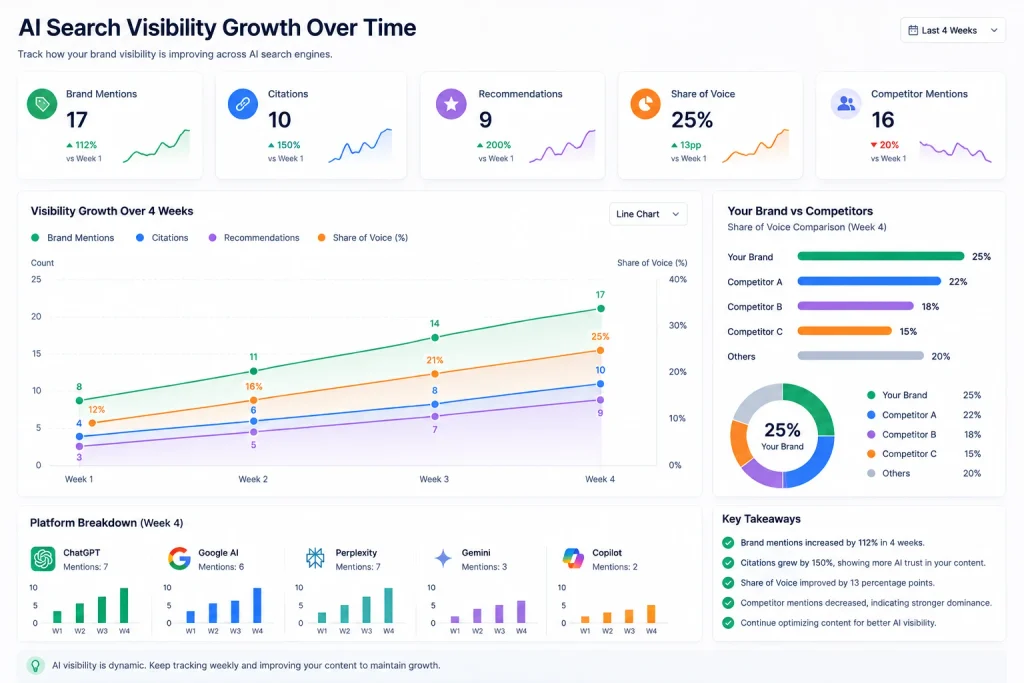
| Metric | Week 1 | Week 2 | Week 3 | Week 4 |
|---|---|---|---|---|
| Brand mentions | 8 | 11 | 14 | 17 |
| Citations | 4 | 6 | 8 | 10 |
| Recommendations | 3 | 5 | 7 | 9 |
| Competitor mentions | 20 | 19 | 18 | 16 |
| Share of voice | 12% | 16% | 21% | 25% |
The numbers above are illustrative, not industry benchmarks.
The goal is to establish your own baseline and monitor whether it changes.
What Metrics Should You Track?
If you’re serious about AI search visibility, don’t track only mentions.
1. Mention Rate
How frequently does your brand appear?
A simple formula:
Mention Rate = Brand Mentions ÷ Total Prompts × 100
2. Citation Rate
How frequently is your website cited as a source?
Citation Rate = Prompts With Your Citation ÷ Total Prompts × 100
3. Recommendation Rate
How often does the AI actively recommend your brand?
This is different from simply mentioning it.
4. Share of Voice
How often does your brand appear compared with competitors?
For example, if your brand appears 20 times across 100 relevant answers, your simple mention share would be 20%.
Don’t treat this as a universal industry-standard metric; different tools can calculate AI share of voice differently.
5. Citation Quality
Don’t count every citation equally.
Ask:
- Is the cited page relevant?
- Is it your strongest page?
- Is the information current?
- Is the source actually supporting the claim?
6. Competitor Visibility
Track which competitors consistently appear.
This can reveal content gaps.
If AI repeatedly recommends Competitor A for a topic but never mentions you, investigate:
What does Competitor A have that your website doesn’t?
7. Brand Accuracy
Check whether AI describes your company correctly.
For example:
Wrong:
“Company X offers 10 free tools.”
Reality:
Company X offers 5 tools, and only 2 are free.
Visibility without accuracy isn’t necessarily good visibility.
Free vs. Paid Ways to Track AI Brand Mentions
You don’t necessarily need to pay for an AI visibility platform on day one.
Free approach
You can start with:
- ChatGPT
- Perplexity
- Google Search
- Google Search Console
- Google Sheets or Excel
- A fixed prompt list
This is enough to establish a baseline.
Simple workflow
20 prompts
↓
5 AI platforms
↓
100 responses
↓
Record:
Mention + Citation + Competitor + Sentiment
↓
Repeat every week.
Paid approach
A dedicated platform becomes more useful when you need:
- Automated monitoring
- Large prompt sets
- Competitor comparisons
- Historical reports
- Client reporting
- Multiple users
- Automated alerts
The key is to prove what you need to monitor before paying for automation.
How to Create an AI Brand Monitoring Workflow
Here’s a simple workflow you can implement today.
Step 1: Define your audience
Who are you trying to appear in front of?
For example:
Small business owners looking for AI marketing tools.
Step 2: Create 20–50 prompts
Build questions around:
- Problems
- Products
- Competitors
- Comparisons
- Categories
- Buying decisions
Step 3: Test multiple AI platforms
Run the same prompts across your selected platforms.
Don’t change the wording every time.
Consistency makes your data more useful.
Step 4: Record the results
Create columns for:
Date | Platform | Prompt | Brand Mention | Recommendation | Citation | Competitors | Sentiment | Source URL
Step 5: Repeat regularly
Weekly is a good starting point for an active brand.
For slower-moving markets, monthly tracking may be sufficient.
The important thing is consistency.
How to Improve Your Brand Visibility in AI Search
Tracking tells you where you are.
The next question is:
How do you improve your visibility?
There isn’t a single trick that guarantees inclusion in AI-generated answers.
Instead, focus on building content and a website that search systems can understand, trust, and cite.
1. Publish genuinely useful content
Don’t create pages simply to target keywords.
Answer real questions better than competing pages.
2. Build topical authority
Cover important questions within your subject instead of publishing dozens of unrelated articles.
3. Create original information
Original research, comparisons, testing, examples, screenshots, and first-hand insights can make your content more useful than generic summaries.
4. Make important information easy to understand
Use:
- descriptive headings
- concise explanations
- tables
- examples
- supporting evidence
- clear definitions
5. Keep your information current
Update:
- pricing
- features
- product names
- screenshots
- statistics
- availability
6. Earn relevant mentions
Build legitimate authority through useful content, partnerships, expert contributions, digital PR, and other genuine mentions.
Don’t buy spammy links simply to manipulate rankings.
7. Continue doing traditional SEO
This is important.
Google’s own current guidance explicitly says that the fundamentals of SEO remain relevant for its generative AI search experiences.
So don’t abandon:
Technical SEO + helpful content + internal linking + crawlability + authority + good user experience.
AI Search Visibility vs. Traditional SEO
The two aren’t competitors.
They’re complementary.
| Traditional SEO | AI Search Visibility |
|---|---|
| Keyword rankings | Brand mentions |
| SERP position | Position within AI answer |
| Organic clicks | AI-referred visits |
| Backlinks | Citations and sources |
| Search queries | Prompts/questions |
| CTR | Mention/recommendation rate |
| Competitor rankings | Competitor AI visibility |
| Rank tracking | AI monitoring |
Think of traditional SEO as:
“Can people find my page?”
AI visibility adds:
“Does AI mention or cite my brand when answering relevant questions?”
Common Mistakes When Tracking AI Brand Mentions
Mistake #1: Checking only once
One AI response isn’t enough to establish a trend.
Mistake #2: Monitoring only one platform
Your brand may appear on one AI engine and disappear on another.
Mistake #3: Searching only your brand name
The most valuable opportunities often come from non-branded category questions.
Mistake #4: Ignoring competitors
Knowing who appears instead of you can be more useful than simply knowing that you don’t appear.
Mistake #5: Treating every mention as positive
A negative or inaccurate mention still needs attention.
Mistake #6: Confusing mentions with citations
A brand can be mentioned without its website being cited.
Mistake #7: Expecting stable AI rankings
AI answers can change.
That’s why repeated measurement matters more than a single snapshot.
Free AI Brand Mention Tracking Template
You can copy this structure into Google Sheets or Excel:
| Date | AI Platform | Prompt | Brand Mention | Recommended | Cited | Citation URL | Competitors | Sentiment |
|---|---|---|---|---|---|---|---|---|
| Aug 31 | ChatGPT | Best AI SEO tools? | Yes | Yes | Yes | URL | Brand A, B | Positive |
| Aug 31 | Perplexity | Best AI SEO tools? | No | — | — | — | Brand A, C | — |
| Aug 31 | Google AI | Best AI SEO tools? | Yes | No | Yes | URL | Brand B | Neutral |
Pro tip: Add a Prompt Category column:
- Discovery
- Comparison
- Recommendation
- Problem
- Alternative
- Commercial
This will make your analysis much more useful later.
Frequently Asked Questions
Can you track brand mentions in ChatGPT?
Yes. You can start manually by asking consistent, relevant prompts and recording whether your brand is mentioned, recommended, or cited. ChatGPT Search can provide web-based answers with links to sources, which makes source tracking possible as well.
How do I check if ChatGPT recommends my brand?
Ask category-level questions rather than only searching for your brand name. For example, ask for the best products or services in your category and record whether your brand appears and how it is described.
How do I track my brand in Google AI Overviews?
Create a fixed set of relevant Google queries and record whether an AI Overview appears, whether your brand is mentioned, and whether your website is cited. Google has also expanded documentation around generative AI features and their relationship with Search.
What is AI brand monitoring?
AI brand monitoring is the process of regularly checking how AI-powered search and answer systems mention, recommend, cite, and describe your brand.
What is AI search visibility?
AI search visibility describes how frequently and prominently your brand appears in AI-generated answers for relevant questions.
How often should I track AI brand mentions?
For an active brand, weekly monitoring gives you a useful recurring signal. Monthly monitoring can work for smaller or slower-moving businesses.
What tools can track AI brand mentions?
Several dedicated AI visibility platforms now monitor combinations of ChatGPT, Gemini, Claude, Perplexity, Google AI experiences, mentions, citations, competitors, and related metrics. Features and pricing change frequently, so verify the current offering directly with each provider before subscribing.
Is AI visibility the same as SEO?
No. AI visibility is an additional layer of search visibility. Traditional SEO remains important, including for Google’s generative AI search features.
Final Takeaway
AI search is creating a new way for people to discover brands.
Instead of measuring only:
“Where does my website rank?”
businesses increasingly need to ask:
“When people ask AI about my industry, does my brand appear?”
The best way to answer that question is to build a repeatable monitoring system.
Start with a list of 20–50 realistic prompts. Test them across multiple AI search platforms. Record mentions, recommendations, citations, competitors, and sentiment. Then repeat the process regularly.
Once you understand your baseline, you can decide whether you need a dedicated AI visibility platform.
And remember: there is no magic GEO trick that guarantees an AI system will recommend your brand. The strongest foundation is still useful, original, trustworthy content combined with solid technical SEO and a website that search engines can access and understand. Google’s current guidance reinforces that established SEO practices remain relevant even as AI-powered search evolves.