
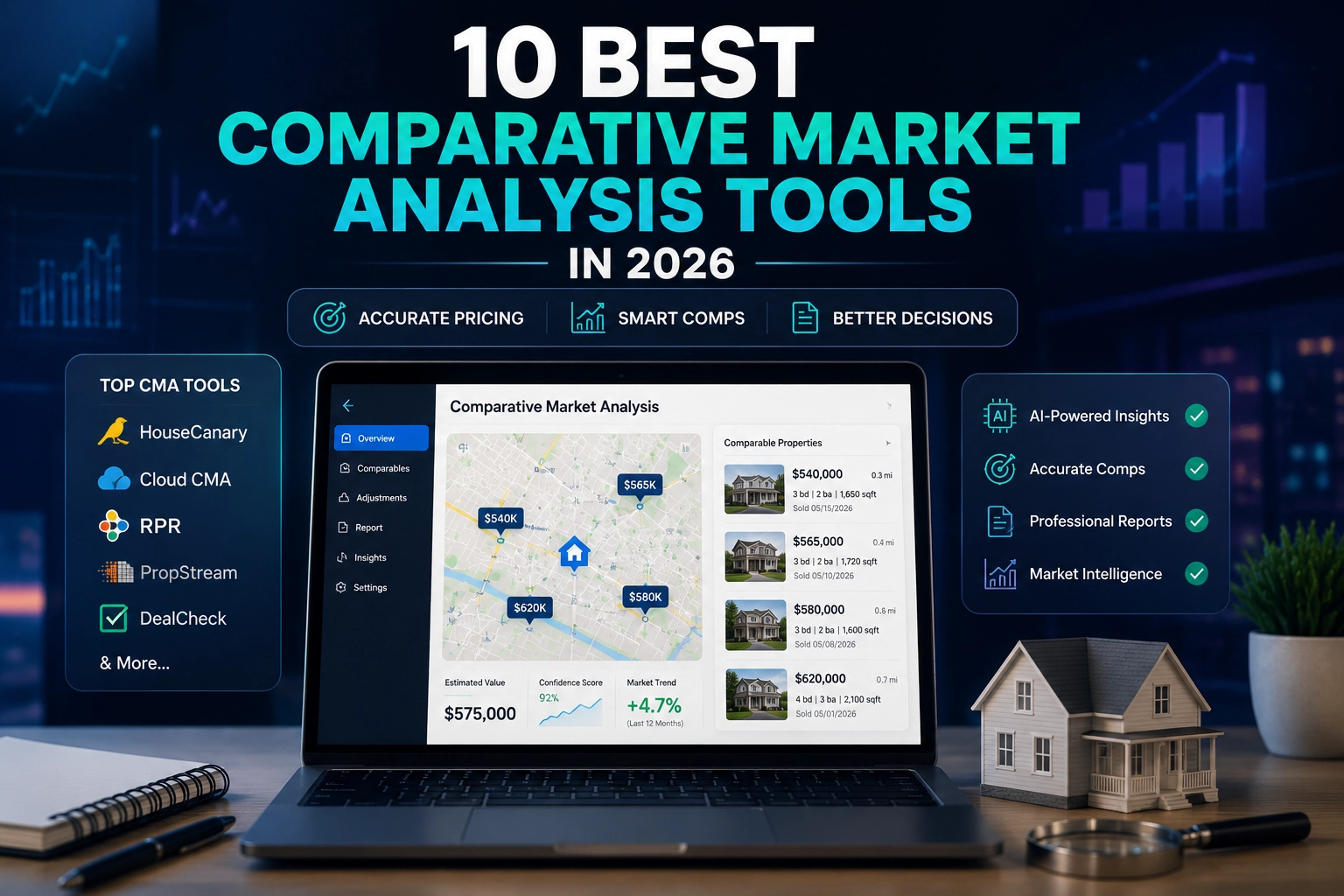
Finding the right property value can be difficult when you’re relying on outdated listings, spreadsheets, or a single automated estimate.
A comparative market analysis tool makes the process much easier by helping real estate agents, investors, and property professionals find comparable properties, analyse recent sales, estimate market value, and create professional reports.
But not every CMA platform works the same way.
Some tools are designed specifically for real estate agents and listing presentations. Others focus on AI-powered valuations, property data, investment analysis, or off-market research.
In this guide, we tested and compared 10 of the best comparative market analysis tools in 2026, looking at their valuation capabilities, comparable-property data, reporting features, AI functionality, pricing approach, and ideal use cases.
Quick answer: HouseCanary is one of the strongest options for AI-powered valuation and real estate analytics, while Cloud CMA is particularly useful for professional listing presentations. RPR is a strong option for eligible REALTORS®, and PropStream is better suited to investors who need extensive property and lead data.
Best Comparative Market Analysis Tools at a Glance
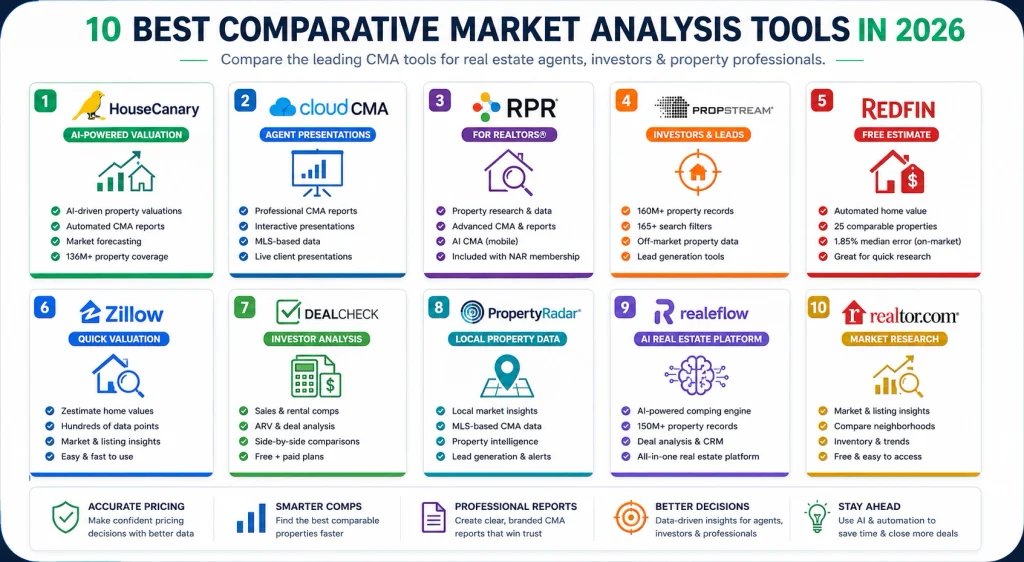
| Tool | Best For | AI / Automation | Reports | Starting Point |
|---|---|---|---|---|
| HouseCanary | AI-powered valuation | Excellent | Yes | Paid |
| Cloud CMA | Agent presentations | Good | Excellent | Paid |
| RPR | REALTORS® | AI CMA | Excellent | Included for eligible NAR members |
| PropStream | Investors & off-market research | AI-powered | Yes | Paid |
| Redfin Estimate | Quick property estimates | Machine learning | Basic | Free |
| Zillow Zestimate | Initial valuation research | Machine learning | Basic | Free |
| DealCheck | Investors & ARV analysis | Automated | Yes | Free + paid |
| PropertyRadar | Local comps & investor research | Automated | Yes | Paid |
| Realeflow | AI real estate platforms | Advanced AI | Yes | Business-focused |
| Realtor.com | Market research | Automated | Basic | Free |
What Is a Comparative Market Analysis Tool?
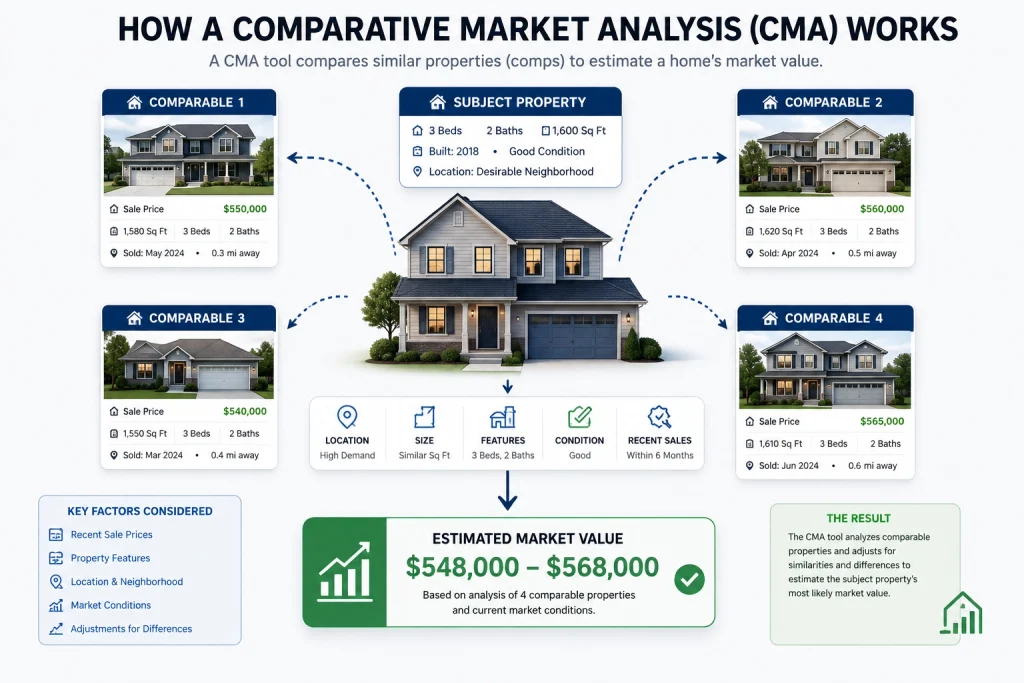
A comparative market analysis (CMA) estimates a property’s potential market value by comparing it with similar properties, commonly known as comps.
A traditional CMA usually looks at factors such as:
- Recent sale prices
- Location
- Property size
- Number of bedrooms and bathrooms
- Property type
- Age and condition
- Lot size
- Renovations and upgrades
- Current listings
- Market conditions
A CMA is different from a professional appraisal. For example, Zillow explicitly states that its Zestimate is not an appraisal and recommends using additional research, a professional appraisal, or a CMA from a real estate agent when appropriate.
For a deeper explanation of how CMAs work, see Zillow’s guide to Comparative Market Analysis and the Massachusetts government CMA guidance.
1. HouseCanary — Best AI-Powered CMA Tool
HouseCanary is one of the most interesting choices if you want a comparative market analysis tool that combines property data, automated valuation models, forecasting, and AI-powered analytics.
Instead of relying on a simple price-per-square-foot calculation, HouseCanary combines large-scale property datasets with machine-learning models and valuation technology.
The platform currently provides access to valuations, CMAs, market forecasts, property analytics, and AI-driven insights. HouseCanary says its platform covers more than 136 million properties.
Why HouseCanary stands out
- AI-powered property valuation
- Automated CMA reports
- Property-level analytics
- Market forecasting
- Extensive property database
- AI assistant functionality
- Tools for agents, investors, lenders, and brokers
HouseCanary also offers specific plans for verified real estate agents, including CMA functionality. Its current agent pricing starts at $19/month for the Basic plan, while the Pro plan provides unlimited CMAs subject to fair-use conditions.
Best for
Real estate agents, investors, analysts, and professionals who want more than a basic CMA.
Verdict
Best overall for AI-powered real estate valuation and analytics.
2. Cloud CMA — Best for Real Estate Listing Presentations
Cloud CMA takes a different approach.
Instead of focusing primarily on advanced valuation analytics, Cloud CMA puts a strong emphasis on creating professional, client-facing CMA reports and presentations.
The platform is designed for real estate agents who need to turn property data into a presentation they can use with buyers and sellers.
Cloud CMA also provides an interactive “Live” presentation mode and uses MLS data for its CMA workflow.
Key features
- CMA reports
- Interactive presentations
- Buyer tours
- Property reports
- MLS-based data
- Custom presentations
- Client-friendly reporting
This makes it particularly useful when the goal isn’t simply to calculate a number, but to explain the pricing recommendation to a client.
Best for
Real estate agents who care about presentation quality and winning listings.
Verdict
One of the strongest CMA tools for client presentations.
3. RPR — Best CMA Tool for REALTORS®
Realtors Property Resource (RPR) is a property-data platform created specifically for REALTORS®.
According to the National Association of REALTORS®, RPR provides property data, analytics, and reports and is available exclusively to REALTORS®. The service is included with annual NAR dues rather than requiring a separate subscription.
RPR is particularly interesting because it combines property research with reporting and valuation functionality.
Its CMA system also offers different workflows. The standard CMA provides simpler adjustments, while the Advanced CMA allows more precise adjustments and weighting of comparable properties.
RPR has also introduced an AI CMA inside its mobile application, designed to help agents analyse comparable properties faster without replacing the agent’s expertise.
Best features
- Property research
- CMA reports
- Advanced CMA
- Market trends
- Property reports
- AI CMA
- Mobile access
Best for
REALTORS® who already have access to RPR through NAR membership.
Verdict
One of the best-value options for eligible REALTORS®.
4. PropStream — Best for Real Estate Investors
PropStream is more than a traditional CMA platform.
It is designed around real estate data, property research, lead generation, comps, and investment analysis.
PropStream says its platform provides data on more than 160 million properties and includes more than 165 filters for identifying specific types of properties and leads.
This makes it particularly interesting for investors who want to combine valuation with lead generation.
What you can use it for
- Comparable sales research
- Property analysis
- Off-market property research
- Lead generation
- Demographic research
- Investment analysis
- Property filtering
- AI-powered insights
If you’re a wholesaler, house flipper, landlord, or investor, this broader functionality can be more useful than a traditional CMA report.
Best for
Real estate investors and professionals researching off-market opportunities.
Verdict
Best choice when CMA analysis is only one part of your investment workflow.
5. Redfin Estimate — Best Free Starting Point
Redfin’s Home Value Estimator is not a traditional professional CMA platform, but it can be extremely useful for initial property research.
Redfin combines data about the property, neighbourhood, and wider market to produce an automated estimate. Its current published figures show a median error rate of 1.85% for on-market homes and 7.26% for off-market homes, although accuracy varies by property and location.
Redfin also provides an Owner Estimate that allows homeowners to select comparable properties from a group of recently sold homes. The system currently identifies 25 potentially comparable properties, from which homeowners can select at least five.
Best for
- Homeowners
- Buyers
- Sellers
- Initial property research
- Finding nearby sold properties
Important limitation
Redfin itself makes clear that its automated estimate is a starting point, not a professional appraisal or a replacement for expert pricing advice.
Verdict
Excellent free starting point, but not a replacement for a professional CMA.
6. Zillow Zestimate — Best for Quick Online Valuation
Zillow Zestimate is probably the best-known automated home valuation tool on this list.
Zillow says its Zestimate incorporates public records, MLS data, user-submitted information, property characteristics, comparable homes, listing information, and market trends. Its models analyse hundreds of data points for individual properties.
The major advantage is simplicity.
You enter a property and receive an automated estimate without needing to build a full CMA manually.
What Zillow is useful for
- Initial property research
- Market-value estimates
- Historical valuation trends
- Comparing properties
- Understanding local market activity
However, Zillow clearly states that a Zestimate is not an appraisal and should not be treated as one.
Best for
Homeowners, buyers, sellers, and anyone who needs a quick valuation starting point.
Verdict
One of the easiest free valuation tools for preliminary research.
7. DealCheck — Best for Investors and ARV Analysis
DealCheck is particularly useful for investors who need to go beyond a basic property estimate.
The platform lets users research recent sales comps, rental comps, ARV estimates, market statistics, and investment metrics.
DealCheck can display recent comparable sales and calculate estimated after-repair value using comparable-property data.
It also supports property comparisons, allowing investors to analyse multiple properties side-by-side.
Useful features
- Sales comps
- Rental comps
- ARV analysis
- Investment calculations
- Property comparison
- Professional reports
- Cloud synchronisation
- Custom branding
The free plan currently allows users to analyse and save up to 15 properties, while paid plans add additional functionality.
Best for
House flippers, rental investors, wholesalers, and property analysts.
Verdict
A strong option when you want CMA-style comps combined with investment analysis.
8. PropertyRadar — Best for Local Property Research
PropertyRadar is another platform worth considering, particularly for investors and professionals who need detailed local property research.
PropertyRadar explains that a traditional MLS-based CMA normally considers sold, pending, and active properties and adjusts for differences in size, age, condition, and amenities.
The platform is also built around property data and lead generation, making it more useful for professionals who want to connect valuation research with prospecting.
Best for
- Property investors
- Local market research
- Real estate professionals
- Lead generation
- Comparable-property research
Verdict
A good choice for professionals who want property intelligence alongside CMA research.
9. Realeflow — Best for AI Real Estate Platforms
Realeflow takes the idea of a CMA tool in a different direction.
Rather than simply giving users a valuation interface, Realeflow provides an AI-powered real estate infrastructure that includes property data, comping, deal analysis, lead generation, CRM functionality, and other real estate workflows.
Its comping engine is designed to pull local property comps and help users price offers, listings, and ARVs.
Realeflow also says its AI tools are built around a proprietary dataset containing more than 150 million property records and are retrained against real market outcomes.
Best for
Real estate businesses, brokerages, educators, and companies that need a broader AI-powered platform.
Verdict
An interesting choice for businesses looking beyond a traditional CMA application.
10. Realtor.com — Best for Additional Market Research
Realtor.com is another useful source for property and market research.
While it isn’t a dedicated professional CMA platform like Cloud CMA or RPR, listing marketplaces can provide valuable context when evaluating comparable properties.
You can use real estate marketplaces to examine:
- Current asking prices
- Nearby listings
- Property characteristics
- Market competition
- Listing history
- Local inventory
The key is to understand that active listings are not the same as completed sales.
A property listed for $600,000 does not prove that buyers are actually paying $600,000 for similar homes.
That’s why sold comparables remain a critical component of a strong CMA.
Comparative Market Analysis Tools: How We Compared Them
Not every platform should be judged using the same criteria.
A tool designed for a REALTOR® listing presentation has different priorities from a platform built for a house flipper.
For this comparison, the most important factors are:
1. Comparable-property data
The quality of the comps is arguably the foundation of any CMA.
A good platform should make it easy to identify properties that are genuinely comparable in terms of:
- Location
- Property type
- Size
- Bedrooms
- Bathrooms
- Age
- Condition
- Lot size
- Recent sale date
2. Valuation technology
Modern CMA software increasingly combines traditional comparable sales with automated valuation models and machine learning.
That can make the process faster, but automated estimates should still be treated as estimates rather than guaranteed sale prices.
3. Report quality
If you’re an agent presenting a CMA to a seller, presentation matters.
A professional report should make the reasoning behind the recommended price easy to understand.
This is one area where tools such as Cloud CMA and RPR have a clear advantage.
4. Market data
A property doesn’t exist in isolation.
The best platforms also provide information about:
- Local market trends
- Inventory
- Recent sales
- Days on market
- Price changes
- Neighbourhood activity
5. AI and automation
AI can reduce the amount of manual research required.
For example, RPR now offers AI-assisted CMA functionality, while HouseCanary and Realeflow use AI and machine learning as part of broader valuation and property-data workflows.
CMA Tool vs. Automated Home Value Estimator
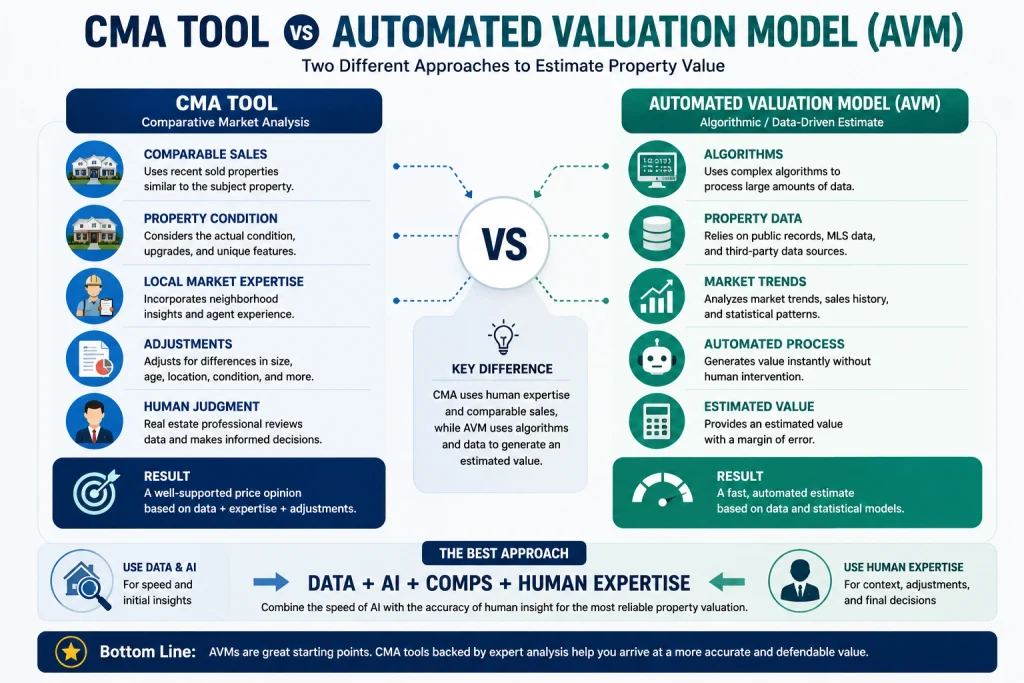
This is one of the most important distinctions to understand.
A comparative market analysis tool is generally designed around analysing comparable properties and producing a pricing opinion or report.
An automated valuation model (AVM) uses algorithms and available data to estimate a property’s value automatically.
Zillow’s Zestimate and Redfin Estimate are examples of automated valuation tools.
They can be extremely useful, but they don’t necessarily understand every characteristic that could influence a property’s actual selling price.
For example:
- A newly renovated kitchen
- A poor interior condition
- A unique floor plan
- A premium view
- A noisy road
- An unusual lot
- Recent structural improvements
Some of these factors may not be fully represented in the available data.
Redfin itself notes that an agent can consider unique characteristics and renovations that an automated system may miss.
That’s why the strongest workflow often combines data + comparable sales + automated valuation + human expertise.
How to Choose the Best Comparative Market Analysis Tool
The best option depends on what you’re trying to accomplish.
Choose HouseCanary if:
You need AI-powered valuation, property analytics, forecasts, and professional CMA functionality.
Choose Cloud CMA if:
You’re a real estate agent who needs polished CMA presentations for sellers and buyers.
Choose RPR if:
You’re an eligible REALTOR® and want a powerful property-data and CMA platform included with your NAR membership.
Choose PropStream if:
You’re an investor who wants comps, property data, lead generation, and off-market research in one platform.
Choose Redfin if:
You simply want a free starting point for estimating a home’s value and finding recent nearby sales.
Choose Zillow if:
You want a quick automated estimate and broad property-market information.
Choose DealCheck if:
You’re an investor who needs comps, ARV calculations, deal analysis, and property comparisons.
Choose PropertyRadar if:
Your workflow depends heavily on local property data and prospecting.
Choose Realeflow if:
You’re interested in AI-powered real estate infrastructure and automated comping.
How to Perform a Better CMA in 2026
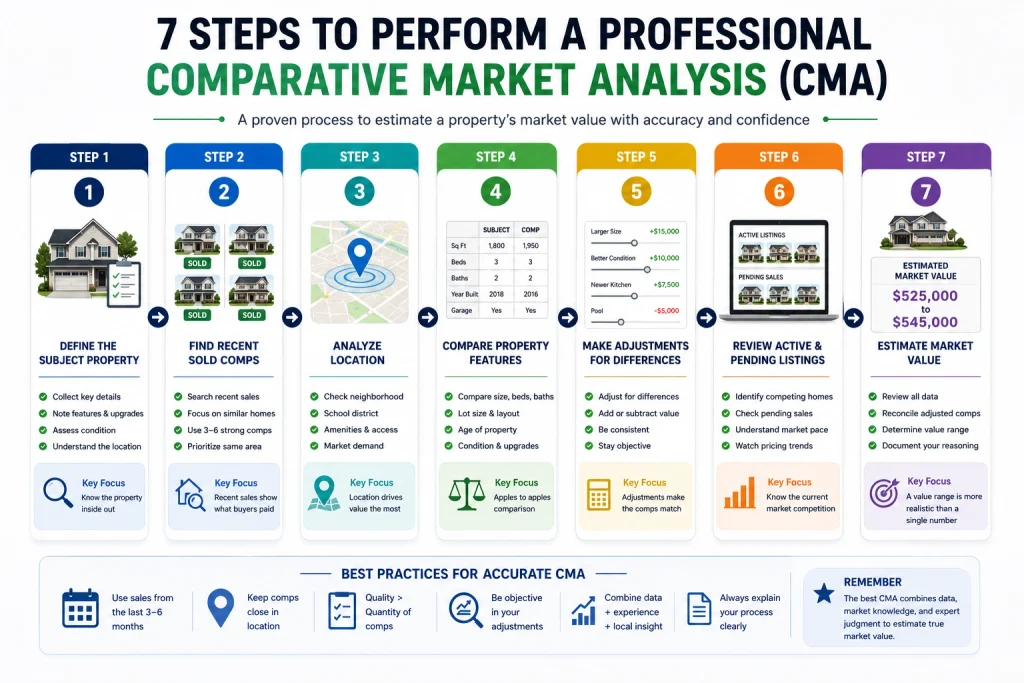
Using a CMA tool doesn’t automatically guarantee an accurate valuation.
The quality of your inputs still matters.
Step 1: Start with the subject property
Record the important characteristics of the property you’re analysing:
- Address
- Property type
- Living area
- Bedrooms
- Bathrooms
- Lot size
- Year built
- Condition
- Renovations
- Garage or parking
- Special features
Step 2: Find recent sold comps
Start with properties that have actually sold rather than relying entirely on current asking prices.
Recent sales give you evidence of what buyers actually paid.
Zillow notes that the most accurate comparable homes are typically those sold within the previous three to six months, although market conditions and location can require broader searches.
Step 3: Keep the location tight
A property 10 miles away isn’t necessarily comparable just because it has the same number of bedrooms.
Neighbourhood, school district, transport access, street quality, and local demand can have a major impact.
Step 4: Compare physical characteristics
Look at:
- Square footage
- Bedrooms
- Bathrooms
- Lot size
- Age
- Condition
- Renovations
- Property type
Step 5: Adjust for meaningful differences
If a comparable property is substantially larger or has significantly better renovations, don’t treat its sale price as directly equivalent.
The goal isn’t to find an identical house.
The goal is to estimate what the comparable property might have sold for if it were more similar to the subject property.
Step 6: Review active and pending listings
Active properties can show you what your competition looks like.
Pending properties can provide additional insight into current buyer demand, although final sale prices may not yet be public.
Step 7: Compare multiple valuation signals
Don’t blindly accept one number.
Compare:
CMA value + AVM estimate + recent sold comps + active competition + local market conditions
This gives you a much stronger picture than relying on one automated estimate.
Are Free Comparative Market Analysis Tools Good Enough?
For basic research, yes.
For professional pricing decisions, usually not by themselves.
Free tools such as Zillow and Redfin can provide valuable starting information, and their automated models can process enormous amounts of property data.
But a professional CMA requires context.
For example, Zillow itself explains that its Zestimate is not an appraisal and recommends supplementing it with additional research, an appraisal, or a CMA from a real estate agent.
So the best approach is not:
“Which website gives me the highest number?”
Instead, ask:
“Which combination of data gives me the most defensible valuation?”
Frequently Asked Questions
What is the best comparative market analysis tool?
There isn’t one universal winner.
For AI-powered valuation and analytics, HouseCanary is one of the strongest options.
For presentation-focused CMAs, Cloud CMA is a strong choice.
For eligible REALTORS®, RPR offers significant value because it combines property data, reports, and CMA functionality within the NAR ecosystem.
What is the best free CMA tool?
For preliminary research, Redfin Estimate and Zillow Zestimate are two of the most useful free options.
However, neither should automatically be treated as a professional appraisal or definitive market value.
Can AI perform a comparative market analysis?
Yes.
Modern platforms can automate comparable-property selection, valuation calculations, report generation, and other parts of the CMA workflow.
RPR, for example, introduced an AI CMA designed to speed up comparable analysis while keeping the agent involved in the pricing conversation.
Is a CMA the same as an appraisal?
No.
A CMA is generally a market-value analysis based on comparable properties, while an appraisal is a formal valuation performed by a qualified appraiser.
Government guidance in Massachusetts, for example, explicitly distinguishes a CMA prepared by a real estate licensee from a formal appraisal.
How many comps should be used in a CMA?
There is no universal number that works for every property.
The more important question is whether the comps are genuinely comparable.
Three highly relevant recent sales can be more useful than ten poorly matched properties.
Are Zillow and Redfin estimates accurate?
They can be useful, but accuracy varies by market and property.
Zillow and Redfin both publish information about their models and accuracy, while also making clear that automated estimates are not substitutes for professional valuation advice.
Final Verdict
The best comparative market analysis tool depends on your role.
If you’re a real estate agent focused on professional presentations, Cloud CMA is a strong option.
If you’re a REALTOR® looking for property data and CMA functionality within the NAR ecosystem, RPR deserves serious consideration.
If you need AI-powered valuation and deeper real estate analytics, HouseCanary is one of the most compelling choices in 2026.
For investors, PropStream and DealCheck can be more useful because they combine comparable-property research with broader investment analysis.
And if you’re simply a homeowner or buyer looking for a quick estimate, Zillow and Redfin provide useful free starting points.
The most important lesson is this: a CMA tool should support your decision, not make the decision for you.
The strongest property valuations combine recent comparable sales, reliable market data, automated models, property-specific adjustments, and human knowledge of the local market.
For that reason, the best CMA workflow in 2026 isn’t about finding a single “magic” valuation number. It’s about using the right comparative market analysis software and data sources together to build a valuation you can actually explain and defend.
- How to Track Brand Mentions in AI Search: 7 Best Ways
- Best SEO Tools for Creators in 2026: 15 Tools Worth Using
- What Is a Digital Creator? Definition, Types, Skills, Income & AI Tools in 2026
- Best Travel Business Software in 2026: 10 Tools for Travel Companies
- Best AI Course Creator Tools in 2026: Comparison, Pricing & Features
[…] 10 Best Comparative Market Analysis Tools in 2026 […]