
Looking for the best AI marketing tools for bloggers? In 2026, AI can help bloggers do much more than generate text. The right tools can help you find better topics, improve SEO, create graphics, promote your content on social media, build an email list, create videos, and understand your website traffic.
But using more tools doesn’t automatically mean better results.
The best approach is to choose a small set of tools that solve specific problems in your blogging workflow.
In this guide, we’ll explore the 10 best AI marketing tools for bloggers in 2026, what each tool is best for, how bloggers can use it, and which tools are worth considering if you’re starting with a limited budget.
Quick answer: ChatGPT is a strong all-purpose AI assistant for bloggers, Semrush is useful for SEO research, Canva is excellent for visual content, Buffer helps with social media distribution, and Google Analytics is essential for measuring website performance.
What Are AI Marketing Tools for Bloggers?
AI marketing tools are applications that use artificial intelligence to help with different parts of digital marketing.
For bloggers, these tools can support tasks such as:
- Content research
- Blog topic generation
- Keyword research
- SEO optimization
- Social media marketing
- Graphic design
- Email marketing
- Video creation
- Content repurposing
- Website analytics
- Marketing automation
The important thing is to use AI as a marketing assistant, not as a replacement for your own knowledge and judgment.
Google’s current guidance emphasizes helpful, reliable, people-first content and warns against creating large amounts of low-value content primarily to manipulate search rankings.
Related guide: [INSERT INTERNAL LINK: Best AI Tools for Bloggers]
10 Best AI Marketing Tools for Bloggers
1. ChatGPT — Best Overall AI Marketing Tool for Bloggers
Best for: Content ideas, brainstorming, outlines, content strategy, repurposing, and marketing assistance.
ChatGPT is one of the most flexible AI tools available to bloggers.
Instead of using it simply to generate complete articles, you can use it throughout your entire content marketing workflow.
How Bloggers Can Use ChatGPT
You can use ChatGPT to:
- Generate blog topic ideas
- Create content outlines
- Brainstorm article angles
- Develop content clusters
- Create social media captions
- Repurpose blog posts
- Write video scripts
- Brainstorm email newsletters
- Improve headlines
- Generate FAQ ideas
- Create content calendars
For example, imagine you have written an article about SEO for beginners.
Instead of stopping after publishing the article, you could use ChatGPT to turn that one article into:
- 5 LinkedIn posts
- 5 X posts
- 3 Instagram carousel ideas
- 5 short video scripts
- 1 email newsletter
- 10 future blog topics
This makes your existing content much more valuable.
The Best Way to Use ChatGPT for Blogging
Don’t simply prompt:
“Write a 2,000-word article about SEO.”
A better workflow is:
Research → Outline → Draft → Add original insights → Fact-check → Edit → Publish
Your own experience, examples, screenshots, data, and opinions are what can make the final article genuinely useful.
Verdict: ★★★★★
Best for: Almost every stage of the blogging process.
2. Semrush — Best AI SEO Tool for Bloggers
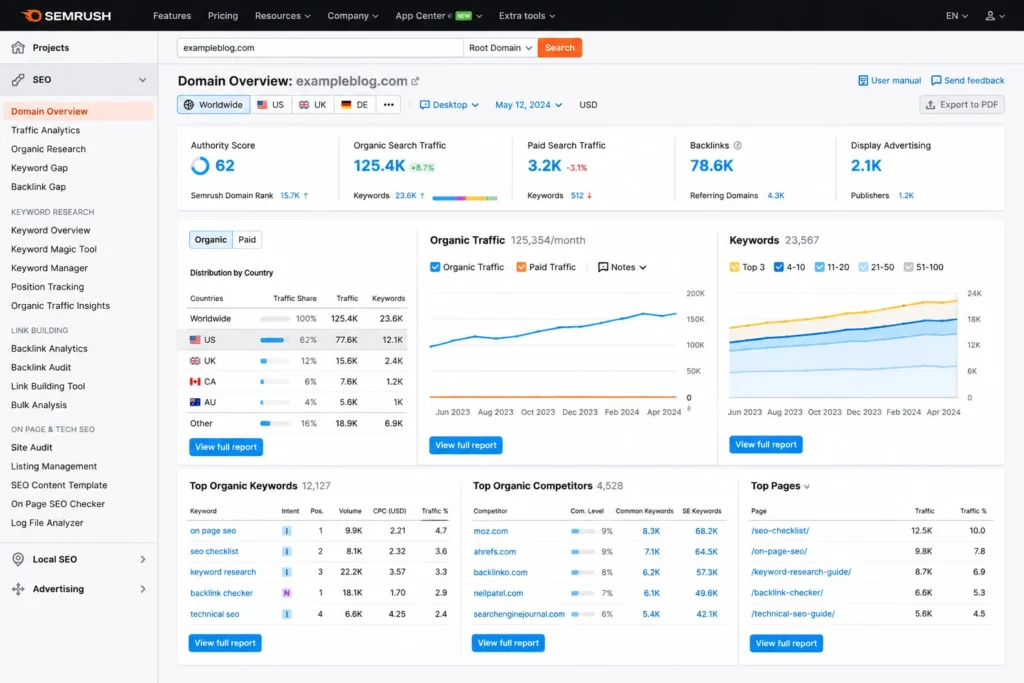
Best for: Keyword research, competitor analysis, SEO, content opportunities, and website analysis.
Semrush is particularly useful for bloggers who want to build their traffic through search engines.
Instead of choosing topics randomly, you can use SEO research to understand what people are searching for and identify opportunities that match your website.
How Bloggers Can Use Semrush
Semrush can help you:
- Research keywords
- Analyze competitors
- Find content gaps
- Discover related topics
- Analyze search intent
- Track keyword rankings
- Audit your website
- Identify SEO opportunities
A simple SEO workflow looks like this:
Keyword → Search Intent → Competition → Content Gap → Article
This is much better than writing about random topics simply because they sound interesting.
Why SEO Tools Matter for Bloggers
Search is becoming more conversational, especially as AI features become more integrated into search engines.
Google says that SEO remains relevant for generative AI search experiences because those experiences still rely on Google’s underlying search and ranking systems.
That means bloggers should continue focusing on strong fundamentals:
- Useful content
- Clear structure
- Search intent
- Internal links
- Crawlability
- Relevant external references
- Good user experience
Verdict: ★★★★★
Best for: Bloggers who take SEO seriously.
Related guide: [INSERT INTERNAL LINK: Best AI SEO Tools for Bloggers]
3. Canva — Best AI Design Tool for Bloggers
Best for: Blog images, Pinterest graphics, social media posts, infographics, and visual marketing.
Canva is a useful tool for bloggers who want professional-looking visuals without becoming graphic design experts.
A blog post doesn’t have to be only text.
You can create visual assets that help you promote the same article on different platforms.
What Can Bloggers Create With Canva?
You can create:
- Featured blog images
- Pinterest pins
- Instagram posts
- Instagram carousels
- Infographics
- YouTube thumbnails
- Ebook covers
- Lead magnets
- Social media graphics
- Promotional banners
A Simple Content Repurposing Strategy
Imagine you’ve published a detailed article about email marketing.
Instead of creating one image, you could turn the article into:
1 blog post → 1 infographic → 5 Pinterest pins → 3 social graphics → 1 Instagram carousel
This gives the article more opportunities to reach new audiences.
Verdict: ★★★★★
Best for: Bloggers who want to combine SEO with social media and visual marketing.
4. Buffer — Best AI Social Media Tool for Bloggers
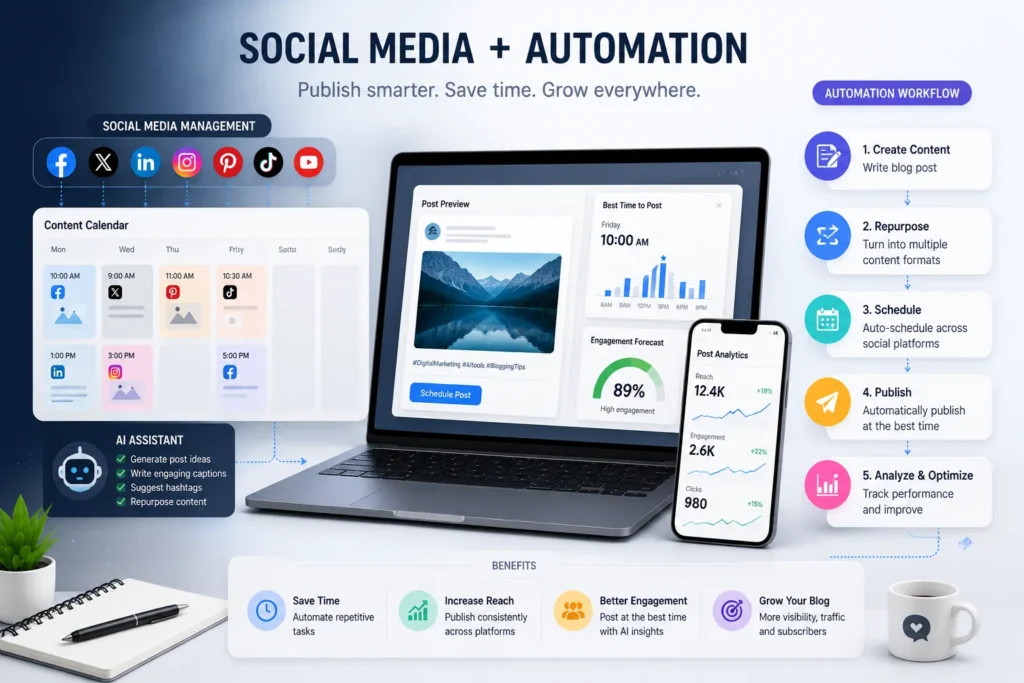
Best for: Social media scheduling, content distribution, and repurposing.
Publishing an excellent blog post doesn’t guarantee that people will discover it.
That’s why content distribution is just as important as content creation.
Buffer helps creators and businesses plan and schedule social media content across multiple platforms. It also provides AI-assisted features for creating and improving posts.
How Bloggers Can Use Buffer
After publishing a new article, create different versions of the same idea for each platform.
For example:
LinkedIn:
Share one important lesson from the article.
X:
Turn one interesting insight into a short post.
Pinterest:
Create a visual pin linking to the article.
Instagram:
Create a carousel summarizing the main points.
YouTube Shorts:
Create a 30–60 second video explaining one tip.
You can then schedule your posts instead of manually publishing every day.
Verdict: ★★★★☆
Best for: Bloggers who want to build traffic beyond Google.
5. Grammarly — Best AI Writing Assistant for Bloggers
Best for: Grammar, clarity, readability, tone, and editing.
Even if AI helped you create the first draft, you should always edit your content before publishing.
Grammarly can help identify grammar issues, unclear sentences, awkward wording, and other writing problems.
Use Grammarly Before Publishing
Check your article for:
- Grammar
- Spelling
- Sentence structure
- Clarity
- Tone
- Repetition
- Readability
However, don’t accept every suggestion automatically.
Your objective isn’t to make your article sound like it was written by software.
Your objective is to make it clear, natural, useful, and enjoyable to read.
Verdict: ★★★★☆
Best for: Final editing before publishing.
6. HubSpot — Best Marketing Automation Tool for Bloggers
Best for: Email marketing, lead generation, CRM, and marketing automation.
Once your blog starts receiving consistent traffic, you shouldn’t rely only on search engines.
You should also try to turn visitors into subscribers.
HubSpot provides marketing and automation tools that can help businesses manage leads, forms, email campaigns, and automated workflows.
A Simple Blog Marketing Funnel
You could build a funnel like this:
Blog Post → Free Resource → Email Signup → Email Sequence → Customer
For example, if you run a blog about SEO, you could create a free:
SEO Checklist for Beginners
A visitor downloads the checklist and joins your email list.
You can then send useful emails related to SEO, content marketing, and website growth.
This transforms your blog from a simple traffic source into a marketing asset.
Verdict: ★★★★☆
Best for: Bloggers building a business around their content.
Related guide: [INSERT INTERNAL LINK: Best Marketing Automation Tools]
7. Surfer — Best Content Optimization Tool for Bloggers
Best for: On-page SEO and content optimization.
Creating useful content should always come first.
After that, tools such as Surfer can help you evaluate and improve the SEO aspects of your content.
How Bloggers Can Use Surfer
You can use content optimization tools to look for:
- Important topics to cover
- Related terms
- Content structure
- Potential gaps
- Opportunities to improve existing articles
But don’t become obsessed with achieving a perfect optimization score.
Google explicitly says there isn’t a preferred word count that guarantees ranking. Content should be created to satisfy users rather than to hit an arbitrary number.
A useful 1,200-word article can be better than an unnecessarily long 3,000-word article.
Verdict: ★★★★☆
Best for: Bloggers who already understand basic SEO and want deeper content optimization.
8. CapCut — Best AI Tool for Turning Blog Posts Into Videos
Best for: Short-form videos, YouTube Shorts, TikTok, Instagram Reels, captions, and video editing.
Your blog content doesn’t have to stay on your website.
You can turn written content into short-form videos and use those videos to introduce new audiences to your blog.
CapCut offers AI-assisted video creation and editing features that can help creators produce short-form content more efficiently.
Turn One Article Into Multiple Videos
Suppose your article is:
10 Ways to Get More Traffic to Your Blog
You could create:
Video 1:
“Why your blog isn’t getting traffic”
Video 2:
“One SEO mistake beginners make”
Video 3:
“How to find better keywords”
Video 4:
“Why publishing more articles isn’t always better”
Video 5:
“How to promote your blog for free”
Each video can introduce one idea and direct viewers to your full article.
This creates a simple content loop:
Blog → Short Video → Social Media → Website → Email Subscriber
Verdict: ★★★★☆
Best for: Bloggers who want to combine blogging with short-form video.
Related guide: [INSERT INTERNAL LINK: Best AI Video Tools for Content Creators]
9. Mailchimp — Best Email Marketing Tool for Bloggers
Best for: Newsletters, email campaigns, subscriber management, and audience retention.
SEO traffic is valuable, but you don’t control Google’s algorithm.
Social media reach can also change.
An email list gives you a direct communication channel with people who have chosen to follow your content.
Mailchimp is one option for bloggers who want to create newsletters and email marketing campaigns.
What Should Bloggers Send?
You can send:
- Weekly newsletters
- New article notifications
- Content roundups
- Free resources
- Helpful tips
- Product recommendations
- Special offers
A simple newsletter could follow this structure:
1 useful tip + 1 recommended article + 1 useful tool
Don’t make every email a sales pitch.
Give subscribers a reason to open your emails.
Verdict: ★★★★☆
Best for: Bloggers who want to build an audience they can reach directly.
Related guide: [INSERT INTERNAL LINK: Best Email Marketing Tools for Bloggers]
10. Google Analytics — Best Analytics Tool for Bloggers
Best for: Traffic analysis, user behavior, conversions, and content performance.
You can’t improve your blog effectively if you don’t know what’s working.
Google Analytics can help you understand how people discover and interact with your website.
What Should Bloggers Measure?
Don’t focus only on pageviews.
Pay attention to:
- Traffic sources
- Landing pages
- Engagement
- Returning visitors
- Conversions
- Referral traffic
- High-performing content
- Underperforming content
The most important question isn’t:
“Which article gets the most traffic?”
Instead, ask:
“Which articles attract the right audience and contribute to my goals?”
For example, an article receiving 1,000 visitors but generating zero subscribers may be less valuable than an article receiving 300 visitors that generates 30 subscribers.
Verdict: ★★★★★
Best for: Every serious blogger.
AI Marketing Tools for Bloggers Comparison
| Tool | Best For | Free Option | Best Use |
|---|---|---|---|
| ChatGPT | Content & strategy | Yes | Brainstorming and planning |
| Semrush | SEO | Limited options | Keyword and competitor research |
| Canva | Design | Yes | Blog and social graphics |
| Buffer | Social media | Yes | Scheduling and distribution |
| Grammarly | Editing | Yes | Grammar and readability |
| HubSpot | Automation | Limited/free tools | Lead generation |
| Surfer | Content optimization | Limited | On-page SEO |
| CapCut | Video | Yes | Short-form video |
| Mailchimp | Email marketing | Plan-dependent | Newsletters |
| Google Analytics | Analytics | Yes | Traffic analysis |
Free plans, features, usage limits, and pricing can change over time. Check each provider’s official website before making a purchasing decision.
What Is the Best AI Marketing Tool for Bloggers?
There isn’t one tool that is perfect for every blogger.
The best choice depends on your main goal.
Best for Content Ideas: ChatGPT
Choose ChatGPT if you need help with brainstorming, outlines, content planning, and repurposing.
Best for SEO: Semrush
Choose Semrush if organic search is an important part of your traffic strategy.
Best for Blog Design: Canva
Choose Canva if you need attractive graphics for your website and social channels.
Best for Social Media: Buffer
Choose Buffer if you want to schedule and distribute your content consistently.
Best for Video Marketing: CapCut
Choose CapCut if you want to turn written content into short-form videos.
Best for Email Marketing: Mailchimp
Choose Mailchimp if building an email audience is one of your priorities.
Best for Analytics: Google Analytics
Choose Google Analytics if you want to understand what is actually happening on your website.
Best Free AI Marketing Tools for Bloggers
If you’re starting a blog with a small budget, you don’t need to subscribe to ten different platforms.
You can start with a simple stack:
Free Blogging Marketing Stack
ChatGPT → Content ideas and planning
Canva → Graphics
Buffer → Social media scheduling
Grammarly → Editing
CapCut → Short videos
Google Analytics → Website analytics
Then upgrade only when you have a clear reason.
For example, once SEO becomes your main traffic source, investing in a professional SEO platform may make more sense.
Related guide: [INSERT INTERNAL LINK: Best Free AI Marketing Tools]
How to Build an AI Marketing Workflow for Your Blog
Using AI effectively isn’t about collecting as many tools as possible.
It’s about creating a repeatable system.
Step 1: Find a Relevant Topic
Start with your audience.
Ask:
- What problems do they have?
- What questions do they ask?
- What information would genuinely help them?
- Can you provide something better than existing content?
Don’t choose a topic simply because it appears to have search volume.
Step 2: Research Keywords and Search Intent
Use SEO tools to understand what people are searching for.
Then determine the intent behind the query.
Is the person looking for:
- Information?
- A tutorial?
- A comparison?
- A product?
- A solution to a problem?
Your article should match that intent.
Step 3: Create a Useful Content Brief
Before writing, define:
- Primary keyword
- Search intent
- Main questions
- Article structure
- Examples to include
- Internal links
- Useful external sources
Related guide: [INSERT INTERNAL LINK: How to Create an SEO Content Brief]
Step 4: Write and Add Original Value
AI can help with the first draft, but don’t publish generic text without reviewing it.
Add:
- Your own examples
- Screenshots
- Personal observations
- Original comparisons
- Data
- Practical instructions
- Pros and cons
Google recommends creating content that provides substantial value beyond simply rewriting information that already exists elsewhere.
Step 5: Optimize the Article
Before publishing, check:
- SEO title
- H1
- H2 and H3 headings
- Primary keyword
- Related terms
- Internal links
- External links
- Image alt text
- Meta description
- Mobile readability
- Page speed
Google’s Search Essentials recommends using words people would actually search for in prominent and descriptive locations, including titles, headings, alt text, and link text.
Step 6: Repurpose Your Content
One article can become multiple pieces of content.
For example:
1 Blog Post
↓
3 Social Posts
↓
5 Pinterest Pins
↓
3 Short Videos
↓
1 Newsletter
This allows you to get more value from the work you’ve already done.
Step 7: Measure and Improve
After publishing, monitor performance.
Look for articles that:
- Receive impressions but few clicks
- Receive traffic but don’t convert
- Rank on page two
- Have declining traffic
- Generate email subscribers
- Bring valuable referral traffic
Then improve those pages instead of constantly publishing new ones.
How Many AI Marketing Tools Does a Blogger Actually Need?
Probably fewer than you think.
You don’t need a separate tool for every small task.
A practical blogging stack could be:
Content: ChatGPT
SEO: Semrush
Design: Canva
Social Media: Buffer
Editing: Grammarly
Video: CapCut
Email: Mailchimp
Analytics: Google Analytics
The goal isn’t to use every available AI marketing tool.
The goal is to build a workflow where every tool solves a real problem.
Common Mistakes When Using AI for Blogging
Publishing AI Content Without Editing
AI-generated text can contain inaccurate information, repetitive language, or generic explanations.
Always review the output.
Focusing on Quantity Instead of Quality
Publishing 100 weak articles isn’t necessarily better than publishing 20 genuinely useful ones.
Google’s guidance explicitly emphasizes people-first content and warns against producing content at scale primarily for search manipulation.
Ignoring Search Intent
A keyword alone doesn’t tell you what the reader wants.
Always look at the type of information that would actually solve the searcher’s problem.
Using Too Many Tools
A complicated marketing stack can waste more time than it saves.
Start small.
Forgetting Content Distribution
Publishing an article and waiting for visitors isn’t a complete marketing strategy.
Promote your content through social media, email, communities, and other relevant channels.
Final Verdict
The best AI marketing tools for bloggers in 2026 aren’t necessarily the tools that generate the most content.
They’re the tools that help you work smarter.
If you’re starting from scratch, begin with:
ChatGPT + Semrush + Canva + Buffer + Google Analytics
Then add tools such as Grammarly, CapCut, Mailchimp, HubSpot, or Surfer when your specific needs justify them.
Most importantly, don’t let AI turn your blog into another website publishing generic content.
Use AI to research faster, brainstorm better ideas, repurpose your best content, automate repetitive tasks, and understand your audience.
Then add the part AI can’t replace easily: your own experience, judgment, examples, and unique perspective.
Google’s current guidance for both traditional Search and generative AI experiences continues to emphasize useful, original, people-first content.
The bloggers who use AI effectively won’t necessarily be the ones publishing the most.
They’ll be the ones creating the most useful content with the smartest workflow.
Frequently Asked Questions
What are the best AI marketing tools for bloggers?
Some of the most useful AI marketing tools for bloggers include ChatGPT for content planning, Semrush for SEO, Canva for design, Buffer for social media, CapCut for video, Mailchimp for email marketing, and Google Analytics for website analytics.
What is the best AI tool for blogging?
ChatGPT is one of the most flexible options because it can assist with brainstorming, research, outlines, content repurposing, and marketing strategy. However, the best tool depends on your specific blogging needs.
Are AI marketing tools free?
Many AI marketing tools offer free plans or limited free features. However, advanced SEO, automation, analytics, and marketing features may require paid plans.
Can AI write blog posts?
Yes, AI can help create blog drafts, outlines, and ideas. However, bloggers should review and improve AI-assisted content before publishing. Adding original information, examples, experience, and analysis can make the content more useful.
Can AI-generated content rank on Google?
Google’s guidance focuses on the quality and usefulness of content rather than simply whether AI was used. AI-assisted content can perform in search when it provides value and follows Google’s Search policies. Content generated primarily to manipulate rankings can violate Google’s spam policies.
What is the best free AI marketing stack for bloggers?
A practical starting stack is ChatGPT for content planning, Canva for graphics, Buffer for social media, Grammarly for editing, CapCut for videos, and Google Analytics for measuring website performance.
Should bloggers use AI to write every article?
Not necessarily. AI can be useful for research, brainstorming, outlining, editing, and repurposing, but relying on it to mass-produce generic articles can reduce the quality of your website. Focus on creating content that genuinely helps your audience.
How can bloggers use AI without hurting SEO?
Use AI as an assistant rather than a content factory. Research your topic, create an original structure, verify important information, add your own insights and examples, edit the final article, and make sure it satisfies the reader’s search intent.
Author’s Note: AI tools, pricing, features, and availability can change frequently. Always verify the current features and pricing on the provider’s official website before choosing a tool.
[…] 10 Best AI Marketing Tools for Bloggers in 2026 […]