
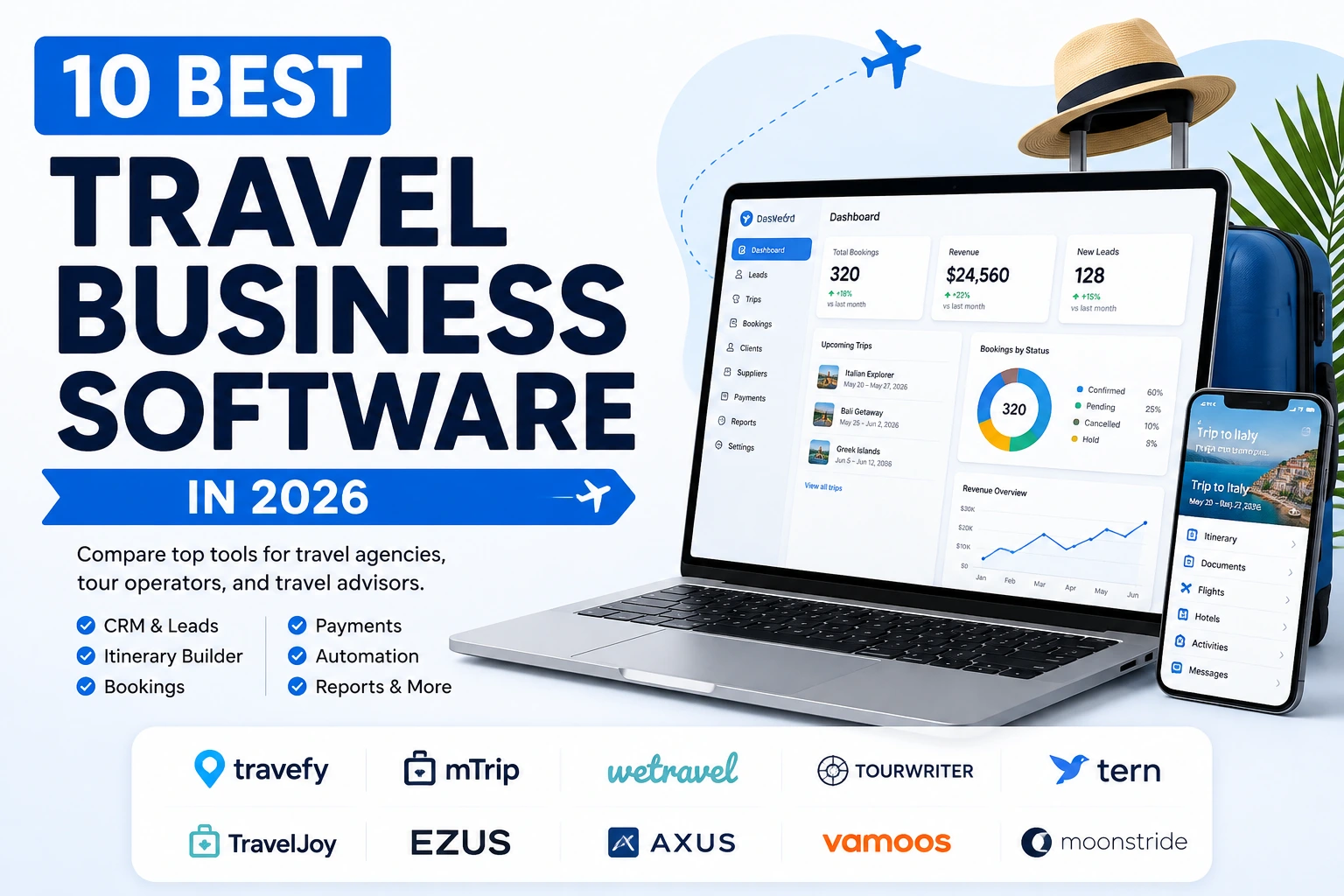
Running a travel business involves much more than booking flights and hotels. You may need to manage leads, build itineraries, collect payments, track commissions, communicate with travelers, coordinate suppliers, and keep every booking organized.
That is where travel business software comes in.
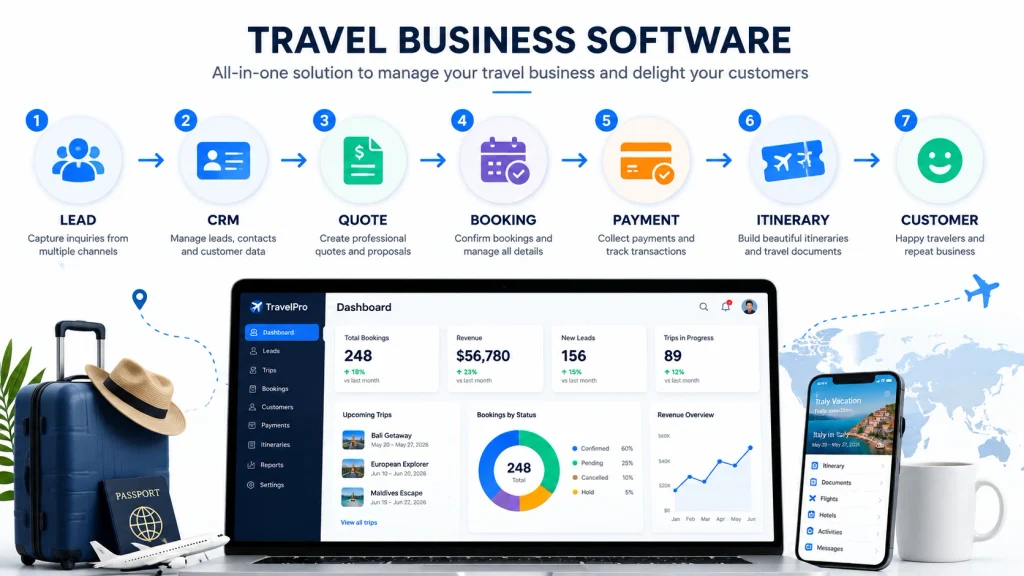
The right platform can replace spreadsheets, scattered emails, manual invoices, separate itinerary builders, and several disconnected tools with a much more organized workflow.
But there is one important catch: not every travel software platform is built for the same type of business.
A solo travel advisor may need CRM and proposal tools. A tour operator may care more about payments and booking management. A luxury DMC may prioritize personalized itineraries and supplier collaboration, while a larger travel company may need GDS integrations, automation, and a branded mobile app.
In this guide, we compare 10 of the best travel business software platforms in 2026, explain what each one does best, and show you how to choose the right option for your business.
Quick Comparison: Best Travel Business Software
| Software | Best For | Main Strength | Starting Price* |
|---|---|---|---|
| Travefy | Travel advisors & small agencies | CRM + itineraries + proposals | $39/month |
| mTrip | Agencies & tour operators | White-label travel experience | Custom |
| WeTravel | Group & multi-day operators | Payments + bookings | $79/month |
| Tourwriter | Luxury & bespoke travel | Trip production | $99/month |
| Tern | Travel advisors & agencies | CRM + automation | $49/month |
| TravelJoy | Small travel agencies | CRM + payments | $19/month |
| Ezus | DMCs & tour operators | Quotes + itinerary production | €75/user/month |
| Axus | Luxury advisors & DMCs | Collaboration + itineraries | $35/seat/month |
| Vamoos | Luxury tour operators | Branded traveler app | From £240/month |
| Moonstride | Growing travel companies | Travel CRM + operations | Custom |
*Pricing can change and some platforms use usage-based, annual, team, or custom pricing. Always verify the current price before purchasing.
What Is Travel Business Software?
Travel business software is a category of digital tools designed to help travel companies manage their daily operations.
Depending on the platform, it can include:
- Customer relationship management (CRM)
- Lead and inquiry management
- Travel itinerary creation
- Proposal and quotation tools
- Booking management
- Payment processing
- Invoicing
- Commission tracking
- Supplier management
- Traveler communication
- Mobile travel apps
- Reporting and analytics
- Automation
- AI-powered workflows
- Integrations with other travel systems
Modern travel software is increasingly becoming an operating system for travel businesses rather than simply an itinerary builder.
For example, WeTravel combines CRM, itinerary creation, payments, booking management, and supplier payments in one platform.
1. Travefy — Best Overall Travel Business Software
Best for: Travel advisors, independent agents, and small-to-medium agencies
Starting price: $39/month when billed annually
If you want an all-in-one platform without building a complicated technology stack, Travefy is one of the strongest options to consider.
The platform combines itinerary and proposal creation with CRM, forms, automations, invoicing, commission tracking, websites, email integration, mobile apps, and AI content import.
Travefy’s current Core plan starts at $39/month billed annually, while Premium starts at $59/month. Additional agency seats can be added separately.
Key features
- Drag-and-drop itinerary builder
- Proposal creation
- CRM
- Forms and automation
- Invoicing
- Commission tracking
- Website and landing page builder
- Mobile apps
- Email integration
- AI content import
- Flight updates
Pros
- Excellent all-in-one approach
- Strong itinerary and proposal tools
- Built specifically for travel professionals
- CRM and back-office tools included
- Transparent pricing
Cons
- Some advanced requirements may require higher plans
- Less suitable for companies that need deep enterprise GDS infrastructure
- Full white-label requirements may require additional solutions
Best for
Travefy makes the most sense for an independent travel advisor or growing agency that wants CRM, proposals, itineraries, and basic business operations in one place.
2. mTrip — Best for White-Label Travel Agencies
Best for: Travel agencies, tour operators, DMCs, and TMCs
Pricing: Custom
If your biggest priority is delivering a professional, branded digital experience to travelers, mTrip deserves serious consideration.
Unlike a basic itinerary builder, mTrip focuses heavily on the client-facing experience. It can consolidate booking information into itineraries and deliver them through a branded mobile app, web portal, and PDF.
The platform supports integrations with Amadeus, Sabre, and Travelport, as well as several mid-office and back-office systems.
Key features
- White-label mobile app
- AI booking import
- Itinerary builder
- Web itinerary portal
- Branded travel documents
- Real-time flight updates
- Traveler messaging
- Offline access
- GDS integrations
- Duty-of-care capabilities
- Multi-brand support
One of mTrip’s biggest differentiators is that agencies can publish the mobile application under their own brand rather than presenting a third-party travel software brand to customers.
Pros
- Excellent white-label capabilities
- Strong client experience
- GDS integrations
- AI-powered document import
- Mobile, web, and PDF delivery
- Suitable for larger travel companies
Cons
- Pricing is customized
- May be more than a small advisor needs
- Not primarily a CRM
Best for
Choose mTrip if your agency already has booking and back-office systems and wants to improve the traveler-facing experience, automation, branding, and itinerary delivery.
3. WeTravel — Best for Group Travel and Payments
Best for: Group tours, retreats, adventure travel, and multi-day travel businesses
WeTravel takes a different approach.
Instead of focusing only on CRM or itinerary design, it attempts to handle the operational side of running multi-day trips.
The platform combines an AI-powered travel CRM, itinerary builder, payment processing, booking management, traveler information, payment plans, inventory, and supplier payments.
Key features
- Travel CRM
- Itinerary builder
- Booking pages
- Payment processing
- Payment plans
- Traveler management
- Passenger manifests
- Inventory management
- Supplier payments
- Multi-currency payments
- APIs
WeTravel currently offers a Pro plan at $79/month, while enterprise pricing is customized. Payment processing fees are separate.
Pros
- Excellent payment infrastructure
- Strong for group trips
- Booking and traveler management
- Multi-currency support
- Payment plans
- API availability
Cons
- Not necessarily the best choice for a luxury advisor focused primarily on bespoke proposals
- Payment fees need to be included in your cost calculation
Best for
If your business sells group tours, retreats, adventure trips, or multi-day experiences, WeTravel is one of the most interesting options on this list.
4. Tourwriter — Best for Luxury and Bespoke Travel
Best for: Luxury travel designers, DMCs, and bespoke tour operators
Tourwriter is designed around a very specific problem: creating and managing highly personalized multi-day travel experiences.
The platform combines itinerary design, CRM, pricing, supplier payments, booking management, tasks, analytics, and accounting integrations.
Key features
- Itinerary builder
- Automatic pricing
- CRM
- Supplier management
- Booking management
- Invoicing
- Payments
- Accounting integrations
- Task management
- Analytics
- Multi-currency workflows
Tourwriter currently lists plans starting at $99/month and positions the platform toward luxury and bespoke travel businesses.
Pros
- Excellent for bespoke itineraries
- Strong financial functionality
- CRM included
- Supplier and booking management
- Good fit for luxury travel
Cons
- May be excessive for a simple travel advisor
- Better suited to businesses with more complex trip production
Best for
Tourwriter is particularly attractive if you sell high-value, customized, multi-stop trips where margins, supplier costs, and itinerary quality matter.
5. Tern — Best for Travel CRM and Automation
Best for: Travel advisors, host agencies, and growing travel teams
Tern is built around the idea of creating a central operating system for travel advisors.
The platform combines contacts, trips, proposals, itineraries, tasks, CRM functionality, reporting, commission reconciliation, and automation.
Key features
- Travel CRM
- Client management
- Trip management
- Proposals
- Itineraries
- Tasks
- Automation
- Commission reconciliation
- Reporting
- AI features
- Team management
Tern’s published agency pricing starts at $39 per seat per month for small agency seat purchases, with lower per-seat pricing at higher volumes. Individual pricing is higher.
Pros
- Strong CRM
- Automation-focused
- Useful reporting
- Commission tracking
- Designed specifically for travel advisors
- Good for growing teams
Cons
- Not the strongest choice if your primary requirement is a sophisticated white-label traveler app
- Some advanced functionality is aimed at larger or more established teams
Best for
Tern is a good choice if your biggest problem isn’t itinerary design — it’s keeping leads, clients, bookings, commissions, and daily tasks organized.
6. TravelJoy — Best for Small Travel Agencies
Best for: Independent advisors and small agencies
TravelJoy is one of the more accessible options for smaller travel businesses.
Its platform combines CRM, proposals, itineraries, payments, forms, messaging, automations, and group booking functionality.
The Starter plan currently costs $19/month, while Pro costs $39/month monthly or $32/month when billed annually.
Key features
- CRM
- Client management
- Itinerary builder
- Proposals
- Payments
- Forms
- Messaging
- Automations
- Group bookings
- Travel insurance tools
- AI features on Pro
Pros
- Affordable entry point
- Easy to understand
- Travel-specific CRM
- Payment processing built in
- Good for independent advisors
Cons
- Starter plan is limited to 12 trips per year
- Payment processing fees apply
- Less appropriate for complex enterprise operations
Best for
If you’re launching a travel agency and want to keep your monthly software costs under control, TravelJoy is one of the first platforms I’d test.
7. Ezus — Best for Tour Proposals and DMCs
Best for: DMCs, tour operators, and travel agencies creating customized trips
Ezus focuses heavily on travel production — turning inquiries into professional quotations, itineraries, and bookings.
Its Professional plan currently starts at €75 per user/month when billed annually, while Premium starts at €100/user/month.
Key features
- Itinerary builder
- Quotation tools
- Traveler websites
- Travel documents
- Interactive maps
- Product and supplier catalog
- Travel CRM
- Task management
- Invoicing
- Payment gateway
- Reservations
- Team collaboration
- Multi-language functionality
Pros
- Strong proposal workflow
- Excellent for customized trips
- CRM included
- Good document creation
- Useful for DMCs and tour operators
Cons
- More expensive than lightweight advisor software
- Per-user pricing can become significant for larger teams
Best for
Ezus is worth considering when your business creates complex, customized travel proposals rather than simple point-to-point bookings.
8. Axus — Best for Luxury Advisor and DMC Collaboration
Best for: Luxury travel advisors, DMCs, and advisor-supplier collaboration
AXUS is particularly interesting for travel professionals who work closely with DMCs and suppliers.
Its strength is collaboration around itinerary production rather than trying to become every company’s entire accounting system.
Key features
- Itinerary management
- Proposal creation
- Supplier collaboration
- Client-facing itineraries
- Mobile access
- Web itineraries
- PDF documents
- Custom branding options
- DMC collaboration
AXUS currently lists pricing at $35 per seat/month, or $329 per seat/year, with different pricing available for DMCs and tour operators.
Pros
- Affordable compared with some enterprise platforms
- Strong itinerary experience
- Useful advisor-DMC collaboration
- 14-day free trial
Cons
- More specialized than an all-in-one business platform
- Some advanced requirements may need additional software
Best for
AXUS makes the most sense for luxury advisors who collaborate heavily with DMCs and suppliers.
9. Vamoos — Best for a Premium Traveler App
Best for: Luxury tour operators, tailormade travel companies, and premium travel brands
Vamoos takes a client-experience-first approach.
Instead of simply giving travelers another PDF, it turns trip information into a branded digital experience containing itineraries, documents, maps, weather, flight updates, and other travel information.
Vamoos says its platform is used by more than 500 travel companies across 50+ countries.
Key features
- Branded travel app
- Offline access
- Interactive maps
- Daily itineraries
- Flight alerts
- Travel documents
- Messaging
- AI image tools
- API integrations
- Custom in-app functionality
Pricing currently starts at £240/month for its Starter level, with pricing based on annual passenger volume.
Pros
- Excellent visual experience
- Strong branding
- Offline functionality
- Excellent for luxury travel
- Useful for repeat engagement
- Open API
Cons
- More expensive than basic itinerary tools
- May be unnecessary for a small advisor with only a few clients
Best for
If your customers pay premium prices and expect a premium experience, Vamoos can help turn the travel app itself into part of your brand.
10. Moonstride — Best for Growing Travel Companies
Best for: Travel agencies, tour operators, and DMCs looking for an integrated platform
Moonstride describes itself as a travel CRM platform designed specifically for the travel industry.
The system provides visibility into enquiries, quotations, bookings, customers, and business performance.
Key features
- Travel CRM
- Enquiry management
- Quotation management
- Booking management
- Customer management
- Reporting
- Supplier integrations
- Cloud-based system
- Modular architecture
- Travel-specific workflows
Pros
- Built specifically for travel
- Strong CRM foundation
- Useful for growing businesses
- Cloud-based
- Integrations available
Cons
- Better suited to established travel businesses than casual advisors
- Pricing requires a conversation
Best for
Moonstride is worth exploring if your travel company needs a central system for sales, enquiries, bookings, and operational workflows.
Travel Business Software Comparison: Which One Should You Choose?
There is no single “best” travel business software for every company.
The right choice depends heavily on your business model.
Best for independent travel advisors
Travefy and TravelJoy are two of the easiest places to start.
They provide the core tools most independent advisors need without forcing them into a complicated enterprise system.
Best for luxury travel
Consider Tourwriter, Vamoos, AXUS, or Ezus.
These platforms are particularly useful when personalized itineraries, visual presentation, supplier collaboration, and client experience are important.
Best for group tours
WeTravel is one of the strongest choices because payments, bookings, traveler information, and trip management are central to the platform.
Best for automation and CRM
Look at Tern, Travefy, or Moonstride.
These platforms can help centralize customer data and reduce repetitive administrative work.
Best for a branded travel app
mTrip and Vamoos stand out.
mTrip is particularly interesting for companies that want deep white-label functionality and integrations, while Vamoos puts a strong emphasis on visual client experience and engagement.
What Features Should You Look for in Travel Business Software?
Before buying anything, don’t just compare the number of features.
Instead, look at how the software fits your actual workflow.
1. CRM and lead management
Your software should make it easy to track:
- New inquiries
- Existing customers
- Travel preferences
- Follow-ups
- Quotes
- Bookings
- Customer history
A CRM becomes especially important as your agency grows.
2. Itinerary builder
A good itinerary builder should let you quickly create:
- Flights
- Hotels
- Activities
- Transfers
- Restaurants
- Tours
- Maps
- Notes
- Documents
The best platforms also allow templates so you don’t have to build every trip from scratch.
3. Booking management
If your team handles dozens or hundreds of bookings, manual spreadsheets become risky.
Look for software that can centralize booking information and reduce duplicate data entry.
4. Payment processing
For tour operators, payment functionality can be just as important as itinerary creation.
Look for:
- Deposits
- Installments
- Payment plans
- Credit cards
- Bank transfers
- Multi-currency payments
- Automated reminders
- Refund management
WeTravel, for example, supports multiple currencies and payment plans.
5. Automation
Automation can eliminate repetitive work such as:
- Follow-up emails
- Payment reminders
- Client notifications
- Booking updates
- Document generation
- Internal tasks
Even saving 10 minutes per booking can add up significantly when your agency handles hundreds of trips.
6. Mobile traveler experience
Ask yourself:
What does my client see after they book?
If the answer is “a collection of PDF attachments,” there may be room for improvement.
Modern platforms can provide:
- Mobile itineraries
- Offline information
- Maps
- Flight alerts
- Messaging
- Digital documents
- Push notifications
This can make the travel experience feel considerably more professional.
Travel Business Software vs Travel Agency Software
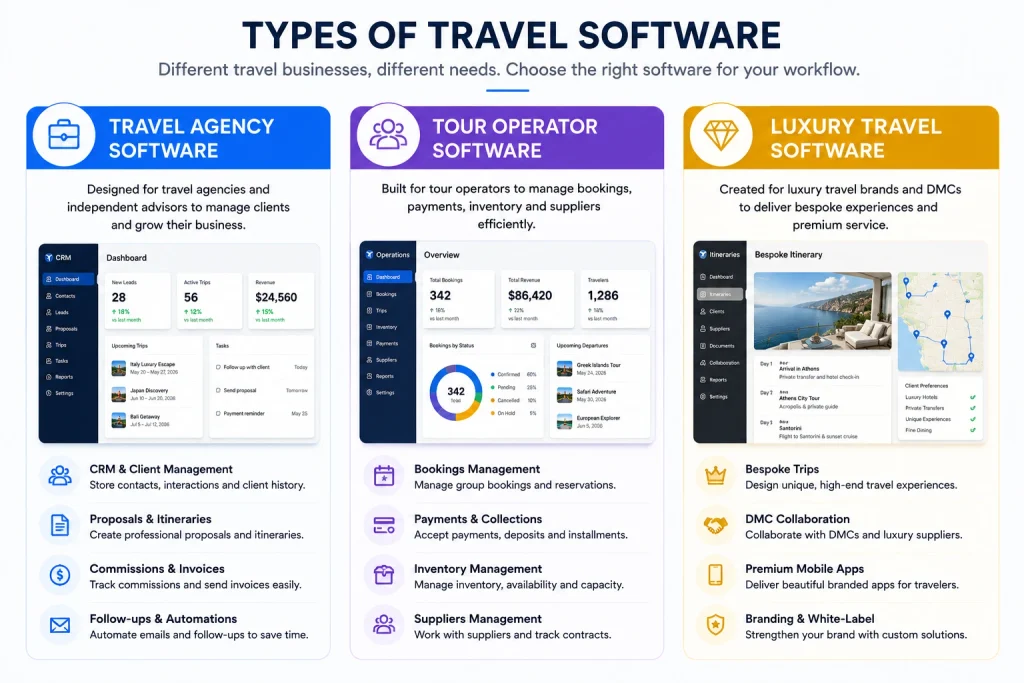
The terms are often used interchangeably, but there is a useful distinction.
Travel agency software usually focuses on the workflow of an agency or travel advisor:
- CRM
- Leads
- Proposals
- Itineraries
- Clients
- Commissions
Travel business software is a broader term that can also include:
- Tour operators
- DMCs
- Group travel companies
- Corporate travel management companies
- Luxury travel companies
- Travel marketplaces
So if you search for travel business software, don’t automatically assume that every travel agency platform will fit your company.
How Much Does Travel Business Software Cost?
Pricing varies dramatically.
A small travel advisor can start with software costing less than $20/month, while larger travel businesses may spend hundreds or thousands of dollars per month depending on users, bookings, integrations, and passenger volume.
For example:
- TravelJoy starts at $19/month.
- Travefy starts at $39/month annually.
- Tern starts at $49/month for an individual subscription, with discounted agency-seat pricing.
- Tourwriter starts at $99/month.
- Ezus starts at €75/user/month annually.
- Vamoos starts at £240/month based on its current Starter pricing.
- WeTravel Pro is currently $79/month before payment-processing costs.
The cheapest platform isn’t necessarily the cheapest solution.
If software saves your team 20 hours every month, prevents booking mistakes, and improves conversion rates, paying more can make financial sense.
Free vs Paid Travel Business Software
Free tools can work when you’re just starting.
For example, you could theoretically manage a tiny operation using:
- Google Sheets
- Gmail
- Google Drive
- Canva
- A basic CRM
- Payment links
But this approach becomes increasingly difficult as your booking volume grows.
Paid travel software becomes more valuable when you need:
- Automation
- Centralized client records
- Payment plans
- Commission tracking
- Supplier management
- Team collaboration
- Professional proposals
- Mobile apps
- Reporting
The goal isn’t to eliminate every tool.
The goal is to eliminate unnecessary manual work.
How to Choose the Best Travel Business Software
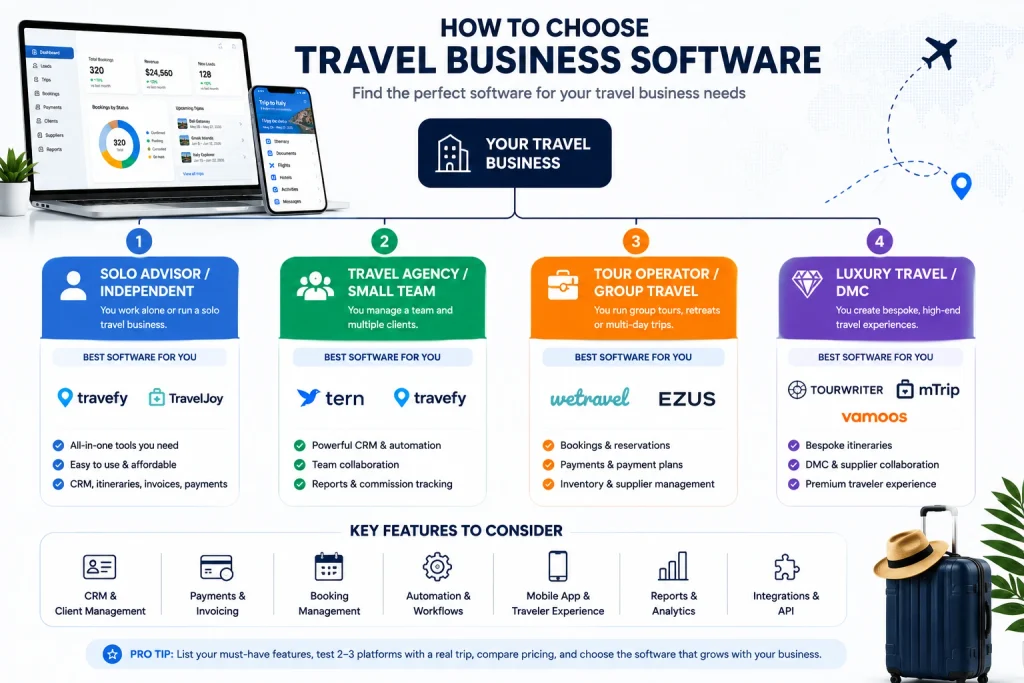
Before signing up, answer these seven questions.
1. What type of travel business do you run?
Are you:
- A solo advisor?
- A travel agency?
- A DMC?
- A tour operator?
- A group travel company?
- A luxury travel company?
- A corporate travel business?
This immediately eliminates many unsuitable platforms.
2. How many people will use the software?
A $39/month solo plan can look cheap until you need 20 seats.
Calculate the real annual cost for your team, not just the advertised entry price.
3. How many trips do you manage?
Some platforms make more sense for low-volume advisors, while others are designed for businesses processing thousands of travelers.
4. Do you need payments?
If you collect deposits and installments directly from travelers, payment functionality should be one of your highest priorities.
5. Do you need a mobile app?
If your customers are primarily luxury travelers or international groups, a branded mobile experience can become a competitive advantage.
6. Do you need integrations?
Check whether the platform works with your:
- GDS
- CRM
- Accounting system
- Booking engine
- Payment provider
- Website
- Marketing tools
Don’t assume an integration exists simply because a vendor says it supports “integrations.”
Check the exact system you use.
7. Can you test it first?
Whenever possible, use a free trial or demo.
Build a real trip from your business instead of testing with a fake example.
That will quickly reveal whether the software actually fits your workflow.
Our Final Ranking
After looking at the different use cases, here’s how we’d narrow the list down:
🥇 Best overall: Travefy
🥈 Best white-label platform: mTrip
🥉 Best for group travel: WeTravel
Best for luxury/bespoke trips: Tourwriter
Best travel CRM: Tern
Best budget-friendly option: TravelJoy
Best for DMCs and customized proposals: Ezus
Best for advisor-DMC collaboration: AXUS
Best premium traveler app: Vamoos
Best for growing travel companies: Moonstride
The important thing is that this isn’t a ranking where #1 automatically beats #10.
For example, a solo advisor may be much better served by TravelJoy than by an enterprise platform like mTrip. A luxury operator may prefer Tourwriter or Vamoos, while a group tour company may get far more value from WeTravel.
Frequently Asked Questions
What is the best travel business software?
Travefy is one of the best all-around choices for travel advisors and smaller agencies because it combines CRM, itineraries, proposals, invoicing, commissions, websites, automation, and mobile apps in one platform.
However, the best software depends on your business model.
What software do travel agencies use?
Travel agencies use a mixture of travel-specific CRM platforms, itinerary builders, booking systems, GDS platforms, payment tools, and accounting software.
Popular options include Travefy, TravelJoy, Tern, mTrip, AXUS, Ezus, and other specialized systems.
What is the best travel agency software for small businesses?
For a small agency or independent advisor, TravelJoy and Travefy are strong starting points because they combine several essential functions without requiring a large enterprise implementation.
What is the best software for tour operators?
For group and multi-day operators, WeTravel is particularly strong because it combines trip creation, bookings, payments, traveler management, and supplier payments.
For bespoke and luxury operators, Tourwriter, Ezus, Vamoos, and mTrip may be better depending on your workflow.
Is travel business software worth it?
Yes, if it removes enough manual work to justify the cost.
The biggest benefits usually come from reducing repetitive administration, centralizing customer data, improving booking accuracy, and creating a better client experience.
Do travel agencies need a CRM?
Not every very small agency needs a dedicated CRM, but CRM functionality becomes increasingly valuable as the number of clients and inquiries grows.
A travel-specific CRM can keep customer information, conversations, bookings, follow-ups, and sales activity connected.
What is white-label travel software?
White-label travel software allows a travel company to deliver software or a mobile app under its own brand instead of displaying the technology provider’s branding.
mTrip, for example, offers a fully branded mobile app published under the agency’s identity.
What is the cheapest travel agency software?
Among the platforms compared here, TravelJoy has the lowest advertised entry price at $19/month, although its Starter plan is limited to 12 trips per year.
Always compare the features and payment fees rather than choosing purely based on the monthly subscription.
Can travel software replace spreadsheets?
For many travel businesses, yes.
A dedicated platform can replace spreadsheets for areas such as:
- Customer records
- Trip information
- Bookings
- Payments
- Supplier data
- Tasks
- Commissions
- Reporting
However, spreadsheets may still be useful for specialized analysis or financial models.
Final Verdict
The best travel business software isn’t necessarily the platform with the longest feature list.
It’s the one that fits the way your company actually sells and delivers travel.
For an independent advisor, Travefy or TravelJoy may be enough.
For a growing agency focused on CRM and automation, Tern is worth a closer look.
For group travel and payment-heavy businesses, WeTravel is a compelling option.
For luxury and bespoke travel, Tourwriter, Ezus, or AXUS can provide a more specialized workflow.
And if your biggest priority is creating a premium branded digital experience for travelers, mTrip or Vamoos stand out.
Before making a purchase, test the software with one of your real trips, calculate the total annual cost for your team, and check every integration you actually need.
The right travel software should not simply add another dashboard to your business. It should remove work from your business.
Pricing and features were checked against publicly available vendor information in 2026. Software companies can change pricing, plans, integrations, and features, so confirm the latest details directly with the provider before purchasing.